
Isopropyl hexanoate
CAS No.:
2311-46-8
M. Wt:
158.23800
M. Fa:
C9H18O2
InChI Key:
JSHDAORXSNJOBA-UHFFFAOYSA-N
Appearance:
Colorless Liquid
Names and Identifiers of Isopropyl hexanoate
CAS Number |
2311-46-8 |
|---|---|
EC Number |
219-000-9 |
MDL Number |
MFCD00059436 |
IUPAC Name |
propan-2-yl hexanoate |
InChI |
InChI=1S/C9H18O2/c1-4-5-6-7-9(10)11-8(2)3/h8H,4-7H2,1-3H3 |
InChIKey |
JSHDAORXSNJOBA-UHFFFAOYSA-N |
Canonical SMILES |
CCCCCC(=O)OC(C)C |
UNII |
84AO2UI60U |
UNSPSC Code |
12352100 |
Physical and chemical properties of Isopropyl hexanoate
Boiling Point |
172.00 to 173.00 °C. @ 760.00 mm Hg |
|---|---|
Density |
0.854-0.860 (20°) |
Exact Mass |
158.13100 |
Flash Point |
54 °C |
H Bond Acceptors |
1 |
H Bond Donors |
0 |
Index of Refraction |
1.405 |
LogP |
3.177 (est) |
Molecular Formula |
C9H18O2 |
Molecular Weight |
158.23800 |
PSA |
26.30000 |
Solubility |
almost insoluble in water; soluble in alcohol |
Vapour Pressure |
1.09mmHg at 25°C |
Safety Information of Isopropyl hexanoate

Applications of Isopropyl hexanoate
Isopropyl hexanoate has various applications across different industries:
- Flavoring and Fragrance: It is commonly used in food products and perfumes to replicate fruity aromas.
- Solvent: Due to its properties as an ester, it serves as a solvent for polar organic compounds.
- Cosmetics: It may be included in cosmetic formulations for its emollient properties.
Interaction Studies of Isopropyl hexanoate
While specific interaction studies on isopropyl hexanoate are scarce, its behavior as a fatty acid ester suggests potential interactions with cell membranes and metabolic pathways related to lipids. Further research could elucidate its role in biological systems and any potential allergenic responses.
Physical sample testing spectrum (NMR) of Isopropyl hexanoate

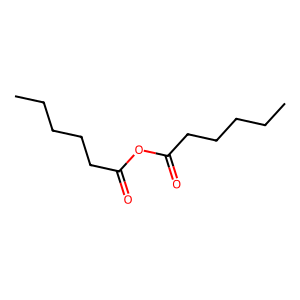 Cas:2051-49-2

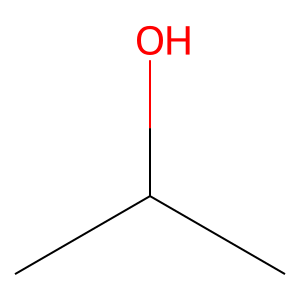 Cas:67-63-0

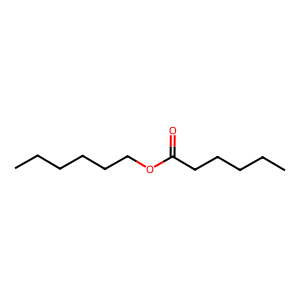 Cas:6378-65-0
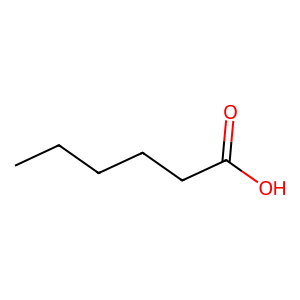 Cas:142-62-1