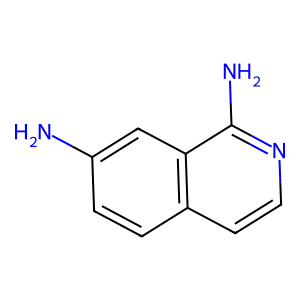
Isoquinoline-1,7-diamine
CAS No.:
244219-96-3
M. Wt:
159.18800
M. Fa:
C9H9N3
InChI Key:
PUIYPHIFMLGHFX-UHFFFAOYSA-N
Names and Identifiers of Isoquinoline-1,7-diamine
CAS Number |
244219-96-3 |
|---|---|
EC Number |
891-491-8 |
MDL Number |
MFCD18802667 |
IUPAC Name |
isoquinoline-1,7-diamine |
InChI |
InChI=1S/C9H9N3/c10-7-2-1-6-3-4-12-9(11)8(6)5-7/h1-5H,10H2,(H2,11,12) |
InChIKey |
PUIYPHIFMLGHFX-UHFFFAOYSA-N |
Canonical SMILES |
C1=CC(=CC2=C1C=CN=C2N)N |
UNSPSC Code |
12352100 |
Physical and chemical properties of Isoquinoline-1,7-diamine
Exact Mass |
159.08000 |
|---|---|
H Bond Acceptors |
3 |
H Bond Donors |
2 |
LogP |
1.91050 |
Molecular Formula |
C9H9N3 |
Molecular Weight |
159.18800 |
PSA |
65.66000 |
Safety Information of Isoquinoline-1,7-diamine

Applications of Isoquinoline-1,7-diamine
Isoquinoline-1,7-diamine has several applications across different fields:
- Pharmaceuticals: Its derivatives are being explored as potential drugs due to their biological activities.
- Chemical Intermediates: Used in the synthesis of more complex organic molecules.
- Material Science: Investigated for use in developing new materials with specific properties due to their unique structural characteristics.
These applications underscore its versatility in both medicinal and industrial chemistry.
Interaction Studies of Isoquinoline-1,7-diamine
Studies on isoquinoline-1,7-diamine interactions have revealed:
- Protein Binding Affinity: Investigations into how this compound interacts with various proteins can provide insights into its mechanism of action as a drug candidate.
- Receptor Binding Studies: Understanding its binding affinity to specific receptors helps elucidate its therapeutic potential and side effects.
These studies are crucial for advancing its application in drug design and development.
Biological Activity of Isoquinoline-1,7-diamine
Isoquinoline-1,7-diamine exhibits notable biological activities, including:
- Antimicrobial Properties: Studies indicate that isoquinoline derivatives can inhibit the growth of various bacteria and fungi.
- Anti-cancer Activity: Some derivatives show promise in inhibiting cancer cell proliferation, making them potential candidates for anticancer drug development.
- Neuroprotective Effects: Research suggests that isoquinoline compounds may protect neuronal cells from oxidative stress and apoptosis.
These activities highlight its potential in pharmaceutical applications.
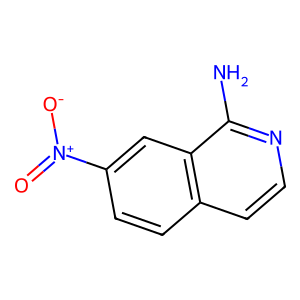 Cas:98410-85-6

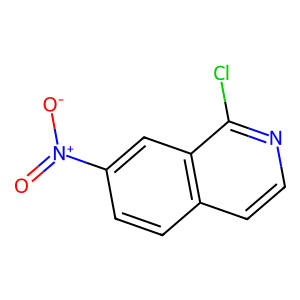 Cas:244219-94-1
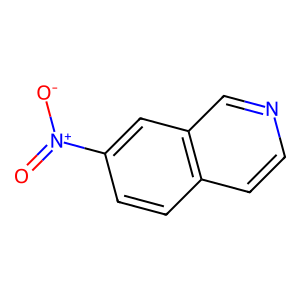 Cas:13058-73-6