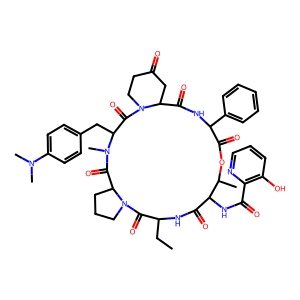
Mikamycin B
Names and Identifiers of Mikamycin B
CAS Number |
3131-03-1 |
|---|---|
MDL Number |
MFCD30489790 |
IUPAC Name |
N-[3-[[4-(dimethylamino)phenyl]methyl]-12-ethyl-4,16-dimethyl-2,5,11,14,18,21,24-heptaoxo-19-phenyl-17-oxa-1,4,10,13,20-pentazatricyclo[20.4.0.06,10]hexacosan-15-yl]-3-hydroxypyridine-2-carboxamide |
InChI |
InChI=1S/C45H54N8O10/c1-6-31-42(59)52-22-11-14-32(52)43(60)51(5)34(24-27-16-18-29(19-17-27)50(3)4)44(61)53-23-20-30(54)25-33(53)39(56)49-37(28-12-8-7-9-13-28)45(62)63-26(2)36(40(57)47-31)48-41(58)38-35(55)15-10-21-46-38/h7-10,12-13,15-19,21,26,31-34,36-37,55H,6,11,14,20,22-25H2,1-5H3,(H,47,57)(H,48,58)(H,49,56) |
InChIKey |
YGXCETJZBDTKRY-UHFFFAOYSA-N |
Canonical SMILES |
CCC1C(=O)N2CCCC2C(=O)N(C(C(=O)N3CCC(=O)CC3C(=O)NC(C(=O)OC(C(C(=O)N1)NC(=O)C4=C(C=CC=N4)O)C)C5=CC=CC=C5)CC6=CC=C(C=C6)N(C)C)C |
UNSPSC Code |
12352100 |
Physical and chemical properties of Mikamycin B
Acidity coefficient |
pKa 7.20±0.05(H2O,t =25,I=0.2(LiClO4)) (Uncertain) |
|---|---|
Boiling Point |
1202.1ºC at 760mmHg |
Density |
1.38g/cm3 |
Exact Mass |
866.39600 |
Flash Point |
680.8ºC |
H Bond Acceptors |
11 |
H Bond Donors |
4 |
Index of Refraction |
1.6910 (estimate) |
LogP |
2.13220 |
Melting Point |
198° |
Molecular Formula |
C45H54N8O10 |
Molecular Weight |
866.95800 |
PSA |
227.96000 |
Solubility |
DMSO (Slightly), Methanol (Slightly) |
Specific rotation |
D22 -57.5° (c = 0.25 in ethanol) |
Storage condition |
-20°C |
Safety Information of Mikamycin B

Interaction Studies of Mikamycin B
Studies have shown that mikamycin B interacts with various cellular components during its mechanism of action. It primarily binds to the ribosomal RNA and alters the ribosome's conformation, enhancing the activity of other streptogramins when used in combination therapy. This synergistic effect is crucial for overcoming bacterial resistance mechanisms and improving therapeutic outcomes against infections.
Biological Activity of Mikamycin B
Mikamycin B exhibits strong biological activity as an antibiotic. It selectively inhibits protein synthesis in bacteria by targeting the 23S ribosomal ribonucleic acid within the 50S ribosomal subunit. This inhibition is synergistic when combined with other streptogramins, enhancing its efficacy against various bacterial strains such as Staphylococcus aureus. The compound's action leads to the release of incomplete peptides and prevents elongation during protein synthesis, making it particularly effective against Gram-positive bacteria.
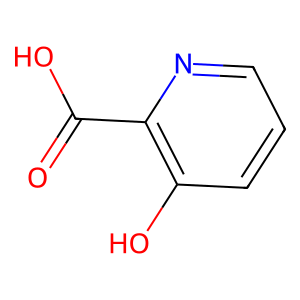 Cas:874-24-8
