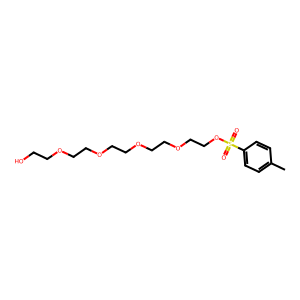
PEG6-Tos
Names and Identifiers of PEG6-Tos
CAS Number |
155130-15-7 |
|---|---|
MDL Number |
MFCD22574780 |
IUPAC Name |
2-[2-[2-[2-(2-hydroxyethoxy)ethoxy]ethoxy]ethoxy]ethyl 4-methylbenzenesulfonate |
InChI |
InChI=1S/C17H28O8S/c1-16-2-4-17(5-3-16)26(19,20)25-15-14-24-13-12-23-11-10-22-9-8-21-7-6-18/h2-5,18H,6-15H2,1H3 |
InChIKey |
NSODVVYOWINKAG-UHFFFAOYSA-N |
Canonical SMILES |
CC1=CC=C(C=C1)S(=O)(=O)OCCOCCOCCOCCOCCO |
UNSPSC Code |
12352100 |
Physical and chemical properties of PEG6-Tos
Acidity coefficient |
14.36±0.10(Predicted) |
|---|---|
Boiling Point |
524.4±50.0 °C at 760 mmHg |
Density |
1.2±0.1 g/cm3 |
Exact Mass |
392.150482 |
Flash Point |
270.9±30.1 °C |
H Bond Acceptors |
7 |
H Bond Donors |
1 |
Index of Refraction |
1.506 |
LogP |
-0.48 |
Molecular Formula |
C17H28O8S |
Molecular Weight |
392.464 |
Vapour Pressure |
0.0±1.4 mmHg at 25°C |
Safety Information of PEG6-Tos

Applications of PEG6-Tos
PEG6-Tos finds extensive applications across various fields:
- Drug Delivery Systems: Its ability to improve solubility and stability makes it ideal for formulating injectable drugs.
- Bioconjugation: Used as a linker for attaching drugs or biomolecules to enhance their therapeutic efficacy.
- Diagnostics: Employed in the development of diagnostic agents due to its hydrophilic properties.
- Tissue Engineering: Utilized in creating hydrogels that mimic biological tissues for regenerative medicine.
Interaction Studies of PEG6-Tos
Interaction studies involving PEG6-Tos typically focus on its conjugates with proteins or small molecules. These studies assess:
- Binding Affinity: Evaluating how well PEG6-Tos-modified compounds bind to target proteins or receptors.
- Stability in Biological Environments: Understanding how PEG6-Tos affects the stability and degradation rates of conjugated drugs.
- Cellular Uptake: Investigating how modifications with PEG6-Tos influence cellular uptake and distribution of therapeutic agents.
Biological Activity of PEG6-Tos
The biological activity of PEG6-Tos is largely attributed to its ability to enhance the solubility and stability of therapeutic agents. Its hydrophilic nature allows for better dispersion in biological fluids, which can improve the pharmacokinetics of conjugated drugs. Additionally, the tosyl group can facilitate interactions with biological molecules, potentially enhancing targeting capabilities in drug delivery systems.
Moreover, studies indicate that PEGylation (the process of attaching polyethylene glycol) can reduce immunogenicity and prolong circulation time in vivo, making PEG6-Tos a valuable component in therapeutic formulations.
Physical sample testing spectrum (NMR) of PEG6-Tos

 Cas:112-27-6

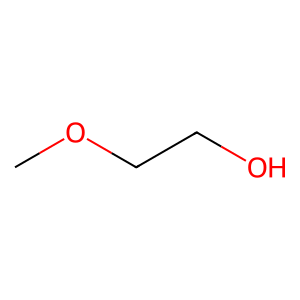 Cas:109-86-4