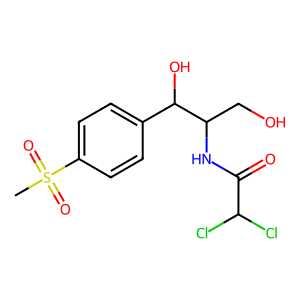
Racephenicol
Names and Identifiers of Racephenicol
CAS Number |
19934-71-5 |
|---|---|
IUPAC Name |
2,2-dichloro-N-[(1S,2S)-1,3-dihydroxy-1-(4-methylsulfonylphenyl)propan-2-yl]acetamide |
InChI |
InChI=1S/C12H15Cl2NO5S/c1-21(19,20)8-4-2-7(3-5-8)10(17)9(6-16)15-12(18)11(13)14/h2-5,9-11,16-17H,6H2,1H3,(H,15,18)/t9-,10-/m0/s1 |
InChIKey |
OTVAEFIXJLOWRX-UWVGGRQHSA-N |
Canonical SMILES |
CS(=O)(=O)C1=CC=C(C=C1)C(C(CO)NC(=O)C(Cl)Cl)O |
Isomeric SMILES |
CS(=O)(=O)C1=CC=C(C=C1)[C@@H]([C@H](CO)NC(=O)C(Cl)Cl)O |
Physical and chemical properties of Racephenicol
Exact Mass |
355.00500 |
|---|---|
LogP |
1.87600 |
Molecular Formula |
C12H15Cl2NO5S |
Molecular Weight |
356.22200 |
PSA |
112.08000 |
Vapour Pressure |
2.5E-20mmHg at 25°C |
Applications of Racephenicol
Racephenicol has several applications across different fields:
- Veterinary Medicine: Primarily used as an antibiotic in veterinary practices to prevent and treat bacterial infections in livestock.
- Research: Serves as a model compound for studying amphenicol antibiotics and bacterial resistance mechanisms.
- Pharmaceutical Development: Investigated for potential use in human medicine, particularly for treating bacterial infections, although its use remains limited compared to other antibiotics.
Interaction Studies of Racephenicol
Racephenicol's interactions have been studied primarily concerning its antibacterial efficacy. It has been shown to interact with various bacterial ribosomal components, enhancing our understanding of how resistance mechanisms develop. These studies help inform the development of new antibiotics that can overcome resistance.
Biological Activity of Racephenicol
Racephenicol exhibits potent antibacterial activity by inhibiting protein synthesis in bacteria. It achieves this by binding to the peptidyl transferase center of the 50S ribosomal subunit, preventing the transfer of amino acids to the growing peptide chain. This inhibition effectively halts bacterial growth and replication, making racephenicol a valuable compound in the fight against bacterial infections.