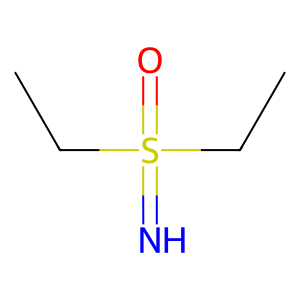
S,S-diethyl-sulfoximine
Names and Identifiers of S,S-diethyl-sulfoximine
CAS Number |
92523-32-5 |
|---|---|
EC Number |
863-350-0 |
IUPAC Name |
diethyl-imino-oxo-λ6-sulfane |
InChI |
InChI=1S/C4H11NOS/c1-3-7(5,6)4-2/h5H,3-4H2,1-2H3 |
InChIKey |
APAXYIMCLKHPKO-UHFFFAOYSA-N |
Canonical SMILES |
CCS(=N)(=O)CC |
Physical and chemical properties of S,S-diethyl-sulfoximine
Boiling Point |
135-140 °C(Press: 0.1 Torr) |
|---|---|
Density |
1.05±0.1 g/cm3(Predicted) |
Molecular Formula |
C4H11NOS |
Molecular Weight |
121.2 |
Safety Information of S,S-diethyl-sulfoximine

Applications of S,S-diethyl-sulfoximine
S,S-diethyl-sulfoximine has several applications across various fields:
- Medicinal Chemistry: It serves as a building block for developing biologically active compounds and pharmaceuticals.
- Agricultural Chemistry: Sulfoximines are explored for their potential as agrochemicals due to their herbicidal and fungicidal properties.
- Material Science: They can be utilized in synthesizing advanced materials with specific electronic or optical properties.
Interaction Studies of S,S-diethyl-sulfoximine
Interaction studies involving S,S-diethyl-sulfoximine focus on its binding affinities with various biological targets. These studies often employ techniques such as molecular docking simulations and enzyme inhibition assays to elucidate how this compound interacts at the molecular level. The results indicate that modifications on the nitrogen atom can significantly influence its biological activity and specificity towards certain targets.
Biological Activity of S,S-diethyl-sulfoximine
S,S-diethyl-sulfoximine exhibits notable biological activity, particularly in pharmacological contexts. Research indicates that sulfoximines can function as inhibitors for various biological targets, including enzymes and receptors involved in disease processes. For instance, certain sulfoximines have shown promise as antitumor agents and in modulating immune responses. The specific activity of S,S-diethyl-sulfoximine may vary depending on its structural modifications and the presence of substituents on the nitrogen atom.