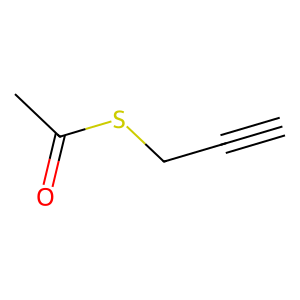
S-prop-2-ynyl ethanethioate
Names and Identifiers of S-prop-2-ynyl ethanethioate
CAS Number |
13702-10-8 |
|---|---|
EC Number |
840-162-7 |
IUPAC Name |
S-prop-2-ynyl ethanethioate |
InChI |
InChI=1S/C5H6OS/c1-3-4-7-5(2)6/h1H,4H2,2H3 |
InChIKey |
UYZVABQVIWVBOC-UHFFFAOYSA-N |
Canonical SMILES |
CC(=O)SCC#C |
Physical and chemical properties of S-prop-2-ynyl ethanethioate
Exact Mass |
114.01400 |
|---|---|
LogP |
0.89930 |
Molecular Formula |
C5H6OS |
Molecular Weight |
114.16600 |
PSA |
42.37000 |
Safety Information of S-prop-2-ynyl ethanethioate


Applications of S-prop-2-ynyl ethanethioate
S-prop-2-ynyl ethanethioate has diverse applications across various fields:
- Agriculture: Primarily used as a pesticide to control mite populations on crops.
- Organic Synthesis: Acts as a reagent for forming carbon-carbon bonds and serves as a protective group for carboxylic acids.
- Biological Research: Valuable for studying enzyme inhibition and nervous system functions due to its acetylcholinesterase inhibitory properties.
- Medicinal Chemistry: Investigated for potential therapeutic uses against parasitic infections .
Interaction Studies of S-prop-2-ynyl ethanethioate
Research into the interactions of S-prop-2-ynyl ethanethioate focuses on its mechanism of action as an acetylcholinesterase inhibitor. Studies have demonstrated that binding at the active site of the enzyme prevents the breakdown of acetylcholine, leading to increased neurotransmitter levels and subsequent neurotoxic effects on target pests . Further studies are needed to explore interactions with other biological systems and potential off-target effects.
Biological Activity of S-prop-2-ynyl ethanethioate
S-prop-2-ynyl ethanethioate exhibits significant biological activity, particularly as an inhibitor of acetylcholinesterase. This enzyme plays a crucial role in the nervous system by breaking down acetylcholine, a neurotransmitter. By inhibiting this enzyme, S-prop-2-ynyl ethanethioate leads to an accumulation of acetylcholine, causing paralysis and death in target pests such as mites. This mechanism underpins its effectiveness as a pesticide .
Additionally, ongoing research is exploring its potential therapeutic applications in medicine, particularly for targeting parasitic infections due to its biological activity .