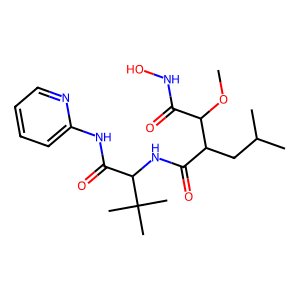
Solimastat
Names and Identifiers of Solimastat
CAS Number |
226072-63-5 |
|---|---|
IUPAC Name |
(2R,3S)-N-[(2S)-3,3-dimethyl-1-oxo-1-(pyridin-2-ylamino)butan-2-yl]-N'-hydroxy-3-methoxy-2-(2-methylpropyl)butanediamide |
InChI |
InChI=1S/C20H32N4O5/c1-12(2)11-13(15(29-6)18(26)24-28)17(25)23-16(20(3,4)5)19(27)22-14-9-7-8-10-21-14/h7-10,12-13,15-16,28H,11H2,1-6H3,(H,23,25)(H,24,26)(H,21,22,27)/t13-,15+,16-/m1/s1 |
InChIKey |
WORSVFBVUCBRIP-VNQPRFMTSA-N |
Canonical SMILES |
CC(C)CC(C(C(=O)NO)OC)C(=O)NC(C(=O)NC1=CC=CC=N1)C(C)(C)C |
Isomeric SMILES |
CC(C)C[C@H]([C@@H](C(=O)NO)OC)C(=O)N[C@H](C(=O)NC1=CC=CC=N1)C(C)(C)C |
UNII |
414MEG73VU |
Physical and chemical properties of Solimastat
Exact Mass |
408.23700 |
|---|---|
LogP |
4.06380 |
Molecular Formula |
C20H32N4O5 |
Molecular Weight |
408.49200 |
PSA |
140.12000 |
Applications of Solimastat
Solimastat has shown promise in various applications:
- Cancer Therapy: Its primary application is in oncology, where it is used as a therapeutic agent to inhibit tumor progression and metastasis.
- Wound Healing: Due to its ability to modulate extracellular matrix remodeling, there is potential for Solimastat in enhancing wound healing processes.
- Fibrosis Treatment: The compound may also be applicable in treating fibrotic diseases where matrix metalloproteinase activity contributes to tissue remodeling.
Interaction Studies of Solimastat
Studies involving Solimastat have focused on its interactions with various matrix metalloproteinases. Molecular dynamics simulations and binding affinity assessments have been conducted to understand how Solimastat interacts with specific enzymes like matrix metalloproteinase-2 and matrix metalloproteinase-9. These studies reveal that Solimastat's unique structural features allow it to fit snugly into the active sites of these enzymes, enhancing its inhibitory effectiveness compared to other inhibitors.
Biological Activity of Solimastat
Solimastat exhibits significant biological activity against various types of cancer by inhibiting matrix metalloproteinases, particularly matrix metalloproteinase-2 and matrix metalloproteinase-9. These enzymes play essential roles in tumor invasion, angiogenesis, and metastasis. Preclinical studies have demonstrated that Solimastat can effectively reduce tumor growth and metastatic spread in animal models, suggesting its potential as a therapeutic agent in cancer treatment.