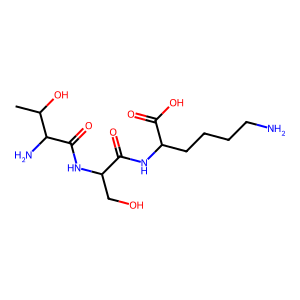
Threonyl-seryl-lysine
Names and Identifiers of Threonyl-seryl-lysine
CAS Number |
71730-64-8 |
|---|---|
IUPAC Name |
(2S)-6-amino-2-[[(2S)-2-[[(2S,3R)-2-amino-3-hydroxybutanoyl]amino]-3-hydroxypropanoyl]amino]hexanoic acid |
InChI |
InChI=1S/C13H26N4O6/c1-7(19)10(15)12(21)17-9(6-18)11(20)16-8(13(22)23)4-2-3-5-14/h7-10,18-19H,2-6,14-15H2,1H3,(H,16,20)(H,17,21)(H,22,23)/t7-,8+,9+,10+/m1/s1 |
InChIKey |
IQPWNQRRAJHOKV-KATARQTJSA-N |
Canonical SMILES |
CC(C(C(=O)NC(CO)C(=O)NC(CCCCN)C(=O)O)N)O |
Isomeric SMILES |
C[C@H]([C@@H](C(=O)N[C@@H](CO)C(=O)N[C@@H](CCCCN)C(=O)O)N)O |
Physical and chemical properties of Threonyl-seryl-lysine
Boiling Point |
770ºC at 760 mmHg |
|---|---|
Density |
1.319g/cm3 |
Exact Mass |
334.18500 |
Flash Point |
419.5ºC |
Index of Refraction |
1.552 |
Molecular Formula |
C13H26N4O6 |
Molecular Weight |
334.36900 |
PSA |
188.00000 |
Applications of Threonyl-seryl-lysine
Threonyl-seryl-lysine has several applications:
- Pharmaceutical Research: Its interaction with LHRH makes it a candidate for developing treatments related to reproductive health.
- Biochemical Studies: The compound serves as a model for studying phosphorylation mimetics in protein interactions.
- Nutraceuticals: Due to its bioactive properties, it may be incorporated into dietary supplements aimed at enhancing hormonal balance.
Interaction Studies of Threonyl-seryl-lysine
Research has shown that threonyl-seryl-lysine interacts specifically with LHRH, influencing its biological activity. This interaction can modulate the release of gonadotropins from the pituitary gland, thereby affecting reproductive functions. Additionally, studies on similar peptides indicate that modifications to the peptide structure can enhance or inhibit these interactions, providing insights into peptide design for therapeutic purposes.
Biological Activity of Threonyl-seryl-lysine
Threonyl-seryl-lysine has demonstrated significant biological activity, particularly in modulating hormonal functions. It binds to LHRH at specific sites, which can affect reproductive hormone regulation. This interaction is crucial in the context of reproductive health and endocrine signaling. Moreover, studies indicate that peptides containing serine and threonine residues can mimic phosphorylated states in proteins, impacting their functional roles in cellular processes.