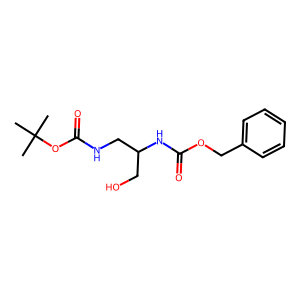
Z-L-Dap(boc)-OL
Names and Identifiers of Z-L-Dap(boc)-OL
CAS Number |
199005-69-1 |
|---|---|
MDL Number |
MFCD06796908 |
IUPAC Name |
benzyl N-[(2S)-1-hydroxy-3-[(2-methylpropan-2-yl)oxycarbonylamino]propan-2-yl]carbamate |
InChI |
InChI=1S/C16H24N2O5/c1-16(2,3)23-14(20)17-9-13(10-19)18-15(21)22-11-12-7-5-4-6-8-12/h4-8,13,19H,9-11H2,1-3H3,(H,17,20)(H,18,21)/t13-/m0/s1 |
InChIKey |
ZRYGVUNFLKWGQH-ZDUSSCGKSA-N |
Canonical SMILES |
CC(C)(C)OC(=O)NCC(CO)NC(=O)OCC1=CC=CC=C1 |
Isomeric SMILES |
CC(C)(C)OC(=O)NC[C@@H](CO)NC(=O)OCC1=CC=CC=C1 |
UNSPSC Code |
12352100 |
Physical and chemical properties of Z-L-Dap(boc)-OL
Exact Mass |
324.16900 |
|---|---|
LogP |
2.58020 |
Molecular Formula |
C16H24N2O5 |
Molecular Weight |
324.37200 |
PSA |
96.89000 |
Safety Information of Z-L-Dap(boc)-OL

Applications of Z-L-Dap(boc)-OL
Z-L-Dap(boc)-OL is primarily utilized in peptide synthesis, serving as an essential building block for creating various peptides and proteins. Its protective groups allow chemists to manipulate amino acids selectively, facilitating complex syntheses that would otherwise be challenging due to side reactions.
Additionally, this compound can be employed in drug development, particularly in creating peptide-based therapeutics that require precise structural configurations.
Interaction Studies of Z-L-Dap(boc)-OL
The interactions of Z-L-Dap(boc)-OL with other molecules are primarily focused on its role as a building block in peptide synthesis. Studies have shown that its protective groups effectively prevent unwanted reactions during the coupling of amino acids, thereby ensuring high yields of desired peptide products. The compound has been investigated for its potential applications in drug delivery systems and targeted therapies due to its structural versatility.
Biological Activity of Z-L-Dap(boc)-OL
Z-L-Dap(boc)-OL plays a significant role in peptide synthesis due to its ability to protect amino groups. This protection ensures that the correct sequence and structure of peptides are maintained during synthesis. The compound's interaction with amino acids allows for precise control over the formation of peptide bonds, which is critical in developing biologically active peptides.
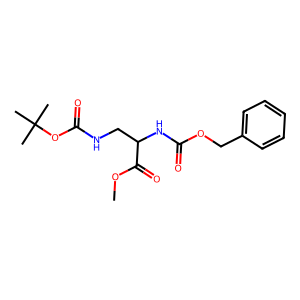 Cas:58457-98-0

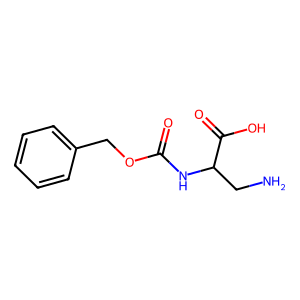 Cas:35761-26-3