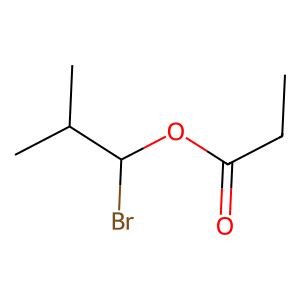
(1-bromo-2-methylpropyl) propanoate
Names and Identifiers of (1-bromo-2-methylpropyl) propanoate
CAS Number |
158894-67-8 |
|---|---|
IUPAC Name |
(1-bromanyl-2-methyl-propyl) propanoate |
Canonical SMILES |
CCC(=O)OC(C(C)C)Br |
Physical and chemical properties of (1-bromo-2-methylpropyl) propanoate
Boiling Point |
193.6ºC at 760 mmHg |
|---|---|
Density |
1.294g/cm3 |
Exact Mass |
208.01000 |
Flash Point |
102.1ºC |
Index of Refraction |
1.456 |
LogP |
2.31660 |
Molecular Formula |
C7H13BrO2 |
Molecular Weight |
209.08100 |
PSA |
26.30000 |
Vapour Pressure |
0.461mmHg at 25°C |
Safety Information of (1-bromo-2-methylpropyl) propanoate


Applications of (1-bromo-2-methylpropyl) propanoate
The applications of 1-bromo-2-methylpropyl propionate span multiple fields:
- Organic Chemistry: Serves as an intermediate for synthesizing other esters and alcohols.
- Biological Research: Utilized in studying enzyme-catalyzed reactions involving ester bonds.
- Pharmaceutical Industry: Investigated for potential uses in drug development and as a reagent for synthesizing pharmaceutical compounds.
- Flavoring and Fragrance Production: Its sweet, fruity odor makes it suitable for use in perfumes and food flavorings.
Interaction Studies of (1-bromo-2-methylpropyl) propanoate
Interaction studies involving 1-bromo-2-methylpropyl propionate focus on its reactivity with various nucleophiles and its behavior under different reaction conditions. These studies are crucial for understanding how the compound can be utilized effectively in synthetic chemistry and biological applications. The mechanism of action primarily revolves around its ability to undergo nucleophilic substitution and hydrolysis reactions, which are fundamental to many organic transformations.
Biological Activity of (1-bromo-2-methylpropyl) propanoate
The biological activity of 1-bromo-2-methylpropyl propionate has been explored in various contexts. Its ester bond makes it relevant in studies involving enzyme-catalyzed reactions that target esters. Additionally, the compound's brominated nature may influence its interaction with biological systems, although specific biological assays are necessary to fully elucidate its pharmacological potential. Research into its use in drug development is ongoing, particularly regarding its role as a reagent in pharmaceutical synthesis.