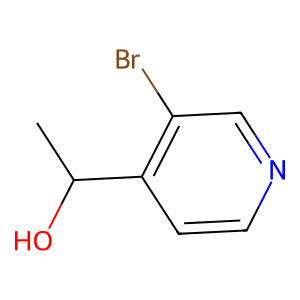
(1R)-1-(3-bromopyridin-4-yl)ethan-1-ol
Names and Identifiers of (1R)-1-(3-bromopyridin-4-yl)ethan-1-ol
CAS Number |
1932164-55-0 |
|---|---|
IUPAC Name |
(1R)-1-(3-bromopyridin-4-yl)ethanol |
InChI |
InChI=1S/C7H8BrNO/c1-5(10)6-2-3-9-4-7(6)8/h2-5,10H,1H3/t5-/m1/s1 |
InChIKey |
UBVWTMPHSNWFEA-RXMQYKEDSA-N |
Canonical SMILES |
CC(C1=C(C=NC=C1)Br)O |
Isomeric SMILES |
C[C@H](C1=C(C=NC=C1)Br)O |
UNSPSC Code |
12352100 |
Physical and chemical properties of (1R)-1-(3-bromopyridin-4-yl)ethan-1-ol
H Bond Acceptors |
2 |
|---|---|
H Bond Donors |
1 |
LogP |
1.17355127166667 |
Molecular Formula |
C7H8BrNO |
Molecular Weight |
202.05 |
Storage condition |
Store at room temperature |
Safety Information of (1R)-1-(3-bromopyridin-4-yl)ethan-1-ol

Applications of (1R)-1-(3-bromopyridin-4-yl)ethan-1-ol
(1R)-1-(3-bromopyridin-4-yl)ethan-1-ol finds applications across several fields:
- Chemistry: It serves as a building block in the synthesis of more complex organic molecules.
- Biology: Investigated for potential biological activities, including interactions with biomolecules.
- Medicine: Explored for drug discovery, particularly in designing new therapeutic agents.
- Industry: Utilized in producing specialty chemicals and intermediates for various industrial processes.
Interaction Studies of (1R)-1-(3-bromopyridin-4-yl)ethan-1-ol
Studies on (1R)-1-(3-bromopyridin-4-yl)ethan-1-ol's interactions with biological systems are essential for understanding its efficacy and potential therapeutic uses. Its mechanism of action likely involves binding to specific molecular targets, influencing their activity through various chemical interactions facilitated by both the bromopyridine moiety and the ethan-1-ol group.
Biological Activity of (1R)-1-(3-bromopyridin-4-yl)ethan-1-ol
Research indicates that (1R)-1-(3-bromopyridin-4-yl)ethan-1-ol may exhibit significant biological activity. It has been investigated for its potential interactions with various biological targets, including enzymes and receptors. The presence of the bromine atom may enhance its ability to modulate biological processes, making it a candidate for further studies in drug discovery and development. Specific studies are needed to elucidate its mechanisms of action and therapeutic potential.