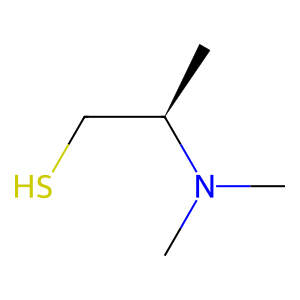
(2R)-2-(dimethylamino)propane-1-thiol
CAS No.:
1807938-37-9
M. Wt:
119.23
M. Fa:
C5H13NS
InChI Key:
-
Names and Identifiers of (2R)-2-(dimethylamino)propane-1-thiol
CAS Number |
1807938-37-9 |
|---|---|
IUPAC Name |
(2R)-2-(dimethylamino)propane-1-thiol |
Canonical SMILES |
C[C@H](CS)N(C)C |
Physical and chemical properties of (2R)-2-(dimethylamino)propane-1-thiol
Acidity coefficient |
9.99±0.10(Predicted) |
|---|---|
Boiling Point |
135.4±23.0 °C(Predicted) |
Density |
0.898±0.06 g/cm3(Predicted) |
Molecular Formula |
C5H13NS |
Molecular Weight |
119.23 |
Applications of (2R)-2-(dimethylamino)propane-1-thiol
(2R)-2-(dimethylamino)propane-1-thiol has several applications across different fields:
- Chemical Industry: Used as an intermediate in the synthesis of pharmaceuticals and agrochemicals.
- Material Science: Employed in the development of polymer additives and stabilizers due to its reactivity.
- Biochemistry: Investigated for its potential role in drug design and development due to its biological activity.
Interaction Studies of (2R)-2-(dimethylamino)propane-1-thiol
Studies on (2R)-2-(dimethylamino)propane-1-thiol focus on its interactions with various biological systems:
- Protein Binding: Research has shown that thiols can form reversible bonds with cysteine residues in proteins, influencing protein function and stability.
- Cellular Uptake: Investigations into how this compound enters cells reveal potential pathways for therapeutic delivery.
These studies contribute to understanding how (2R)-2-(dimethylamino)propane-1-thiol might be utilized in medicinal chemistry.
Biological Activity of (2R)-2-(dimethylamino)propane-1-thiol
(2R)-2-(dimethylamino)propane-1-thiol exhibits notable biological activities. Compounds containing thiol groups are often involved in biological processes such as:
- Antioxidant Activity: Thiols can scavenge free radicals, contributing to cellular protection against oxidative stress.
- Enzyme Interactions: The compound may interact with various enzymes through thiol-disulfide exchange mechanisms, potentially influencing metabolic pathways.
Research indicates that compounds with similar structures can exhibit neuroprotective effects and may be investigated for their potential therapeutic applications.