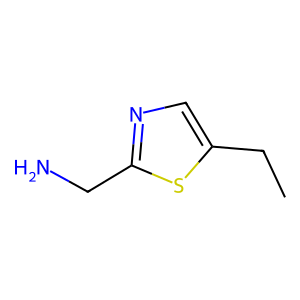
(5-Ethyl-1,3-thiazol-2-yl)methanamine
CAS No.:
1017435-71-0
M. Wt:
142.22
M. Fa:
C6H10N2S
InChI Key:
RXAXYPLDNOJHNJ-UHFFFAOYSA-N
Names and Identifiers of (5-Ethyl-1,3-thiazol-2-yl)methanamine
CAS Number |
1017435-71-0 |
|---|---|
EC Number |
871-851-0 |
MDL Number |
MFCD09904507 |
IUPAC Name |
(5-ethyl-1,3-thiazol-2-yl)methanamine |
InChI |
InChI=1S/C6H10N2S/c1-2-5-4-8-6(3-7)9-5/h4H,2-3,7H2,1H3 |
InChIKey |
RXAXYPLDNOJHNJ-UHFFFAOYSA-N |
Canonical SMILES |
CCC1=CN=C(S1)CN |
UNSPSC Code |
12352100 |
Physical and chemical properties of (5-Ethyl-1,3-thiazol-2-yl)methanamine
Acidity coefficient |
7.53±0.29(Predicted) |
|---|---|
Boiling Point |
218.6±23.0 °C(Predicted) |
Density |
1.138±0.06 g/cm3(Predicted) |
H Bond Acceptors |
2 |
H Bond Donors |
1 |
LogP |
0.921402958666667 |
Molecular Formula |
C6H10N2S |
Molecular Weight |
142.22 |
Safety Information of (5-Ethyl-1,3-thiazol-2-yl)methanamine

Applications of (5-Ethyl-1,3-thiazol-2-yl)methanamine
(5-Ethyl-1,3-thiazol-2-yl)methanamine finds applications primarily in:
- Medicinal chemistry: As a building block for synthesizing new pharmaceutical agents.
- Research: In studies exploring thiazole derivatives and their biological implications.
- Agricultural chemistry: Potentially as a component in agrochemicals due to its biological activity.
Interaction Studies of (5-Ethyl-1,3-thiazol-2-yl)methanamine
Interaction studies involving (5-Ethyl-1,3-thiazol-2-yl)methanamine have focused on its binding affinity with various biological targets. Preliminary data suggest that it may interact with enzymes or receptors relevant to disease pathways, indicating its potential as a lead compound in drug discovery.
Biological Activity of (5-Ethyl-1,3-thiazol-2-yl)methanamine
Research indicates that (5-Ethyl-1,3-thiazol-2-yl)methanamine exhibits notable biological activities. It has been studied for its potential antimicrobial properties and as a precursor to various biologically active compounds. The thiazole moiety is often associated with pharmacological effects, making this compound of interest for drug development.