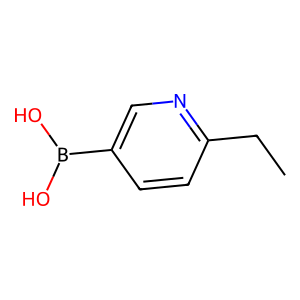
(6-Ethylpyridin-3-yl)boronic acid
Names and Identifiers of (6-Ethylpyridin-3-yl)boronic acid
CAS Number |
1001907-69-2 |
|---|---|
MDL Number |
MFCD16038212 |
IUPAC Name |
(6-ethylpyridin-3-yl)boronic acid |
InChI |
InChI=1S/C7H10BNO2/c1-2-7-4-3-6(5-9-7)8(10)11/h3-5,10-11H,2H2,1H3 |
InChIKey |
LPXSVMTZVQACFE-UHFFFAOYSA-N |
Canonical SMILES |
B(C1=CN=C(C=C1)CC)(O)O |
UNSPSC Code |
12352100 |
Physical and chemical properties of (6-Ethylpyridin-3-yl)boronic acid
Acidity coefficient |
4.29±0.10(Predicted) |
|---|---|
Boiling Point |
298.914ºC at 760 mmHg |
Density |
1.139 g/cm3 |
Exact Mass |
151.08000 |
Flash Point |
134.579ºC |
Molecular Formula |
C7H10BNO2 |
Molecular Weight |
150.97100 |
PSA |
53.35000 |
Storage condition |
under inert gas (nitrogen or Argon) at 2-8°C |
Safety Information of (6-Ethylpyridin-3-yl)boronic acid

Applications of (6-Ethylpyridin-3-yl)boronic acid
(6-Ethylpyridin-3-yl)boronic acid finds applications in various fields:
- Organic Synthesis: It serves as a key intermediate in the synthesis of complex organic molecules, particularly in pharmaceutical chemistry.
- Material Science: Used in the development of polymers and materials that require specific functional groups for reactivity.
- Biochemistry: Its ability to form complexes with diols makes it useful in biochemical assays and as a tool for studying enzyme mechanisms.
Interaction Studies of (6-Ethylpyridin-3-yl)boronic acid
Studies on interaction mechanisms indicate that (6-Ethylpyridin-3-yl)boronic acid can form stable complexes with various biological molecules. These interactions are critical for understanding its role as an enzyme inhibitor and its potential therapeutic applications. Research has shown that modifications to the pyridine ring can significantly influence binding affinity and specificity toward target enzymes.
Biological Activity of (6-Ethylpyridin-3-yl)boronic acid
The biological activity of (6-Ethylpyridin-3-yl)boronic acid has been explored in various studies, particularly its potential as an inhibitor of specific enzymes. Boronic acids are known to interact with serine proteases and other enzymes that utilize diols in their active sites. Such interactions can lead to the development of pharmaceutical agents targeting diseases related to dysregulated enzymatic activity.
Physical sample testing spectrum (NMR) of (6-Ethylpyridin-3-yl)boronic acid
