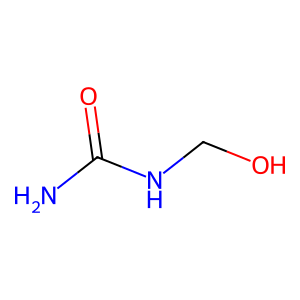
(Hydroxymethyl)urea
Names and Identifiers of (Hydroxymethyl)urea
CAS Number |
1000-82-4 |
|---|---|
EC Number |
213-674-8 |
IUPAC Name |
hydroxymethylurea |
InChI |
InChI=1S/C2H6N2O2/c3-2(6)4-1-5/h5H,1H2,(H3,3,4,6) |
InChIKey |
VGGLHLAESQEWCR-UHFFFAOYSA-N |
Canonical SMILES |
C(NC(=O)N)O |
UNII |
15BY095DMS |
Physical and chemical properties of (Hydroxymethyl)urea
Boiling Point |
237.6ºC at 760 mmHg |
|---|---|
Density |
1.311 g/cm3 |
Exact Mass |
90.04290 |
Flash Point |
97.5ºC |
Melting Point |
111 °C |
Molecular Formula |
C2H6N2O2 |
Molecular Weight |
90.08120 |
PSA |
75.35000 |
Solubility |
VERY SOL IN WATER; SOL IN METHANOL, ACETIC ACID; SOL IN HOT ALCOHOL; INSOL IN ETHER |
Vapour Pressure |
0.00326mmHg at 25°C |
Safety Information of (Hydroxymethyl)urea

Applications of (Hydroxymethyl)urea
(Hydroxymethyl)urea finds diverse applications across various fields:
- Polymer Chemistry: It serves as a modifier and plasticizer for urea-formaldehyde resins, enhancing the material properties of these polymers.
- Cosmetics: Used in cosmetic formulations for its moisturizing properties.
- Corrosion Inhibition: Effective as an inhibitor for steel corrosion in acidic environments, making it valuable in industrial applications.
Interaction Studies of (Hydroxymethyl)urea
Studies on the interaction of (hydroxymethyl)urea with other compounds reveal its potential as a corrosion inhibitor. For example, it has been shown to enhance the protective qualities of coatings applied to metals when exposed to corrosive environments like hydrochloric acid. Additionally, its interactions with biological molecules could lead to novel therapeutic applications.
Biological Activity of (Hydroxymethyl)urea
Research indicates that (hydroxymethyl)urea exhibits various biological activities. It has been shown to possess anti-corrosive properties, making it useful in protecting metals from acidic corrosion. Furthermore, studies suggest that derivatives of (hydroxymethyl)urea may have potential applications in pharmaceuticals due to their ability to interact with biological systems effectively.
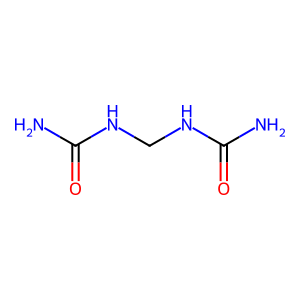 Cas:13547-17-6


 Cas:7732-18-5
 Cas:140-95-4