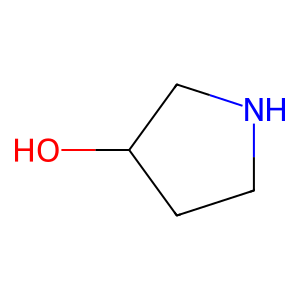
(S)-3-Hydroxypyrrolidine
CAS No.:
100243-39-8
M. Wt:
87.120
M. Fa:
C4H9NO
InChI Key:
JHHZLHWJQPUNKB-BYPYZUCNSA-N
Appearance:
Colorless Semi-Solid
Names and Identifiers of (S)-3-Hydroxypyrrolidine
CAS Number |
100243-39-8 |
|---|---|
MDL Number |
MFCD00192426 |
IUPAC Name |
(3S)-pyrrolidin-3-ol |
InChI |
InChI=1S/C4H9NO/c6-4-1-2-5-3-4/h4-6H,1-3H2/t4-/m0/s1 |
InChIKey |
JHHZLHWJQPUNKB-BYPYZUCNSA-N |
Canonical SMILES |
C1CNCC1O |
Isomeric SMILES |
C1CNC[C@H]1O |
UNII |
PP22TE6CNU |
UNSPSC Code |
12352100 |
Physical and chemical properties of (S)-3-Hydroxypyrrolidine
Acidity coefficient |
14.91±0.20(Predicted) |
|---|---|
Boiling Point |
224.7±0.0 °C at 760 mmHg |
BRN |
4652606 |
Density |
1.1±0.1 g/cm3 |
Exact Mass |
87.068413 |
Flash Point |
105.8±11.0 °C |
Index of Refraction |
1.484 |
LogP |
-1.20 |
Melting Point |
15°C |
Molecular Formula |
C4H9NO |
Molecular Weight |
87.120 |
optical activity |
[α]20/D 6.5±1.5°, c = 3.5% in methanol |
PSA |
32.26000 |
Sensitivity |
Air Sensitive & Hygroscopic |
Specific rotation |
-6.5 º (c=3.5% in MeOH) |
Storage condition |
2-8°C |
Vapour Pressure |
0.0±0.9 mmHg at 25°C |
Water Solubility |
Fully miscible in water. |
Safety Information of (S)-3-Hydroxypyrrolidine

Applications of (S)-3-Hydroxypyrrolidine
(S)-3-Hydroxypyrrolidine has several applications across different fields:
- Pharmaceuticals: It serves as an important intermediate in the synthesis of drugs targeting neurological disorders and infections.
- Chemical Research: Its unique structure makes it a valuable compound for studying reaction mechanisms and developing new synthetic methodologies.
- Agricultural Chemistry: Potential applications in agrochemicals are being explored due to its biological activity against pathogens.
Interaction Studies of (S)-3-Hydroxypyrrolidine
Interaction studies involving (S)-3-hydroxypyrrolidine focus on its ability to bind with various biological targets. These studies reveal insights into:
- Enzyme Inhibition: The compound may act as an inhibitor for certain enzymes, impacting metabolic pathways.
- Receptor Binding: Research indicates potential interactions with neurotransmitter receptors, suggesting implications for its use in treating mood disorders or neurodegenerative conditions.
Biological Activity of (S)-3-Hydroxypyrrolidine
Research indicates that (S)-3-hydroxypyrrolidine exhibits various biological activities. It has been studied for its potential role in:
- Neuroprotective effects: Some studies suggest that it may have protective effects on neurons, making it a candidate for neurodegenerative disease therapies.
- Antimicrobial properties: The compound has shown activity against certain bacterial strains, indicating potential use as an antimicrobial agent.
- Pharmacological applications: Its structural features allow it to interact with biological targets, making it useful in drug discovery.
Physical sample testing spectrum (NMR) of (S)-3-Hydroxypyrrolidine

 Cas:51-35-4

 Cas:101469-91-4
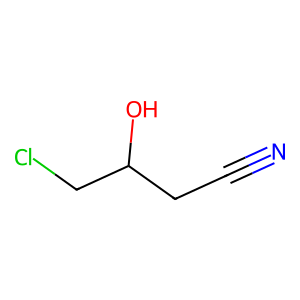 Cas:127913-44-4