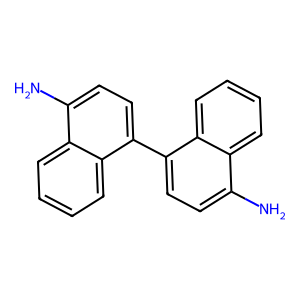
1,1'-Binaphthyl-4,4'-ylenediamine
CAS No.:
481-91-4
M. Wt:
284.35400
M. Fa:
C20H16N2
InChI Key:
RZPBZEISZUFQSV-UHFFFAOYSA-N
Appearance:
Orange Solid
Names and Identifiers of 1,1'-Binaphthyl-4,4'-ylenediamine
CAS Number |
481-91-4 |
|---|---|
EC Number |
207-574-3 |
IUPAC Name |
4-(4-aminonaphthalen-1-yl)naphthalen-1-amine |
InChI |
InChI=1S/C20H16N2/c21-19-11-9-15(13-5-1-3-7-17(13)19)16-10-12-20(22)18-8-4-2-6-14(16)18/h1-12H,21-22H2 |
InChIKey |
RZPBZEISZUFQSV-UHFFFAOYSA-N |
Canonical SMILES |
C1=CC=C2C(=C1)C(=CC=C2N)C3=CC=C(C4=CC=CC=C43)N |
UNII |
GHW4ZAS356 |
Physical and chemical properties of 1,1'-Binaphthyl-4,4'-ylenediamine
Exact Mass |
284.13100 |
|---|---|
LogP |
5.98680 |
Molecular Formula |
C20H16N2 |
Molecular Weight |
284.35400 |
PSA |
52.04000 |
Applications of 1,1'-Binaphthyl-4,4'-ylenediamine
1,1'-Binaphthyl-4,4'-ylenediamine finds applications in several fields:
- Asymmetric Synthesis: It serves as a chiral ligand in asymmetric catalysis, enhancing the enantioselectivity of reactions.
- Polymer Chemistry: Used as a monomer in the production of specialty polymers with enhanced thermal and mechanical properties.
- Dyes and Pigments: It is employed in dye chemistry due to its ability to form colored complexes with metal ions.
These applications underscore its importance in both industrial and research settings.
Interaction Studies of 1,1'-Binaphthyl-4,4'-ylenediamine
Interaction studies involving 1,1'-Binaphthyl-4,4'-ylenediamine have focused on its binding affinities with various biological targets:
- Enzyme Inhibition: Studies have shown that it can inhibit certain enzymes involved in metabolic pathways, suggesting potential therapeutic uses.
- Receptor Binding: Research indicates interactions with specific receptors that could modulate physiological responses.
These interactions are crucial for understanding its mechanism of action and potential therapeutic applications.
Biological Activity of 1,1'-Binaphthyl-4,4'-ylenediamine
Research indicates that 1,1'-Binaphthyl-4,4'-ylenediamine exhibits various biological activities. It has been studied for its potential as:
- Antioxidant: The compound shows promising antioxidant properties, which could be beneficial in preventing oxidative stress-related diseases.
- Anticancer Agent: Some studies suggest that it may inhibit the proliferation of cancer cells due to its ability to interact with biological targets involved in cell growth and survival.
- Antimicrobial Activity: Preliminary investigations indicate that it may possess antimicrobial properties against certain bacterial strains.
These biological activities make it a candidate for further pharmacological studies.
Physical sample testing spectrum (NMR) of 1,1'-Binaphthyl-4,4'-ylenediamine

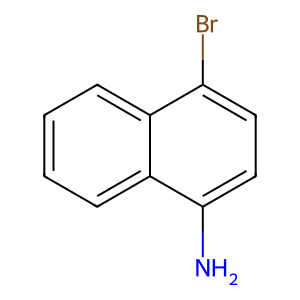 Cas:2298-07-9

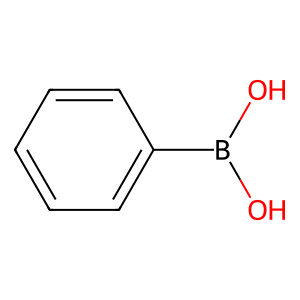 Cas:98-80-6

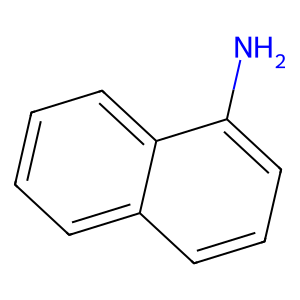 Cas:134-32-7