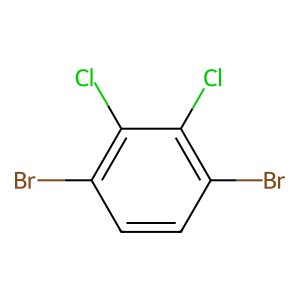
1,4-Dibromo-2,3-dichlorobenzene
CAS No.:
100191-20-6
M. Wt:
304.794
M. Fa:
C6H2Br2Cl2
InChI Key:
YKQCCQSRNJMDMD-UHFFFAOYSA-N
Appearance:
Yellow-brown Solid
Names and Identifiers of 1,4-Dibromo-2,3-dichlorobenzene
CAS Number |
100191-20-6 |
|---|---|
MDL Number |
MFCD09878188 |
IUPAC Name |
1,4-dibromo-2,3-dichlorobenzene |
InChI |
InChI=1S/C6H2Br2Cl2/c7-3-1-2-4(8)6(10)5(3)9/h1-2H |
InChIKey |
YKQCCQSRNJMDMD-UHFFFAOYSA-N |
Canonical SMILES |
C1=CC(=C(C(=C1Br)Cl)Cl)Br |
UNSPSC Code |
12352100 |
Physical and chemical properties of 1,4-Dibromo-2,3-dichlorobenzene
Boiling Point |
298.0±35.0 °C at 760 mmHg |
|---|---|
Density |
2.1±0.1 g/cm3 |
Exact Mass |
301.790009 |
Flash Point |
144.1±16.0 °C |
Index of Refraction |
1.624 |
LogP |
4.57 |
Melting Point |
73 to 75°C |
Molecular Formula |
C6H2Br2Cl2 |
Molecular Weight |
304.794 |
Vapour Pressure |
0.0±0.6 mmHg at 25°C |
Safety Information of 1,4-Dibromo-2,3-dichlorobenzene

Applications of 1,4-Dibromo-2,3-dichlorobenzene
1,4-Dibromo-2,3-dichlorobenzene finds applications in various fields:
- Chemical Intermediates: It serves as an intermediate in the synthesis of other organic compounds.
- Agricultural Chemicals: Potential use in the formulation of pesticides or herbicides due to its reactivity.
- Research: Utilized in laboratory settings for studying reaction mechanisms involving halogenated compounds.
Physical sample testing spectrum (NMR) of 1,4-Dibromo-2,3-dichlorobenzene
