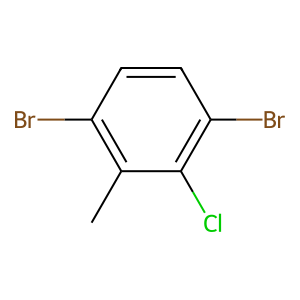
1,4-Dibromo-2-chloro-3-methylbenzene
CAS No.:
1000573-62-5
M. Wt:
284.37600
M. Fa:
C7H5Br2Cl
InChI Key:
FTQQPQNDEZNBJI-UHFFFAOYSA-N
Appearance:
Off-White To Light Brown Solid
Names and Identifiers of 1,4-Dibromo-2-chloro-3-methylbenzene
CAS Number |
1000573-62-5 |
|---|---|
MDL Number |
MFCD09878178 |
IUPAC Name |
1,4-dibromo-2-chloro-3-methylbenzene |
InChI |
InChI=1S/C7H5Br2Cl/c1-4-5(8)2-3-6(9)7(4)10/h2-3H,1H3 |
InChIKey |
FTQQPQNDEZNBJI-UHFFFAOYSA-N |
Canonical SMILES |
CC1=C(C=CC(=C1Cl)Br)Br |
UNSPSC Code |
12352100 |
Physical and chemical properties of 1,4-Dibromo-2-chloro-3-methylbenzene
Exact Mass |
281.84500 |
|---|---|
LogP |
4.17340 |
Melting Point |
56 to 60°C |
Molecular Formula |
C7H5Br2Cl |
Molecular Weight |
284.37600 |
Safety Information of 1,4-Dibromo-2-chloro-3-methylbenzene

Applications of 1,4-Dibromo-2-chloro-3-methylbenzene
3,6-Dibromo-2-chlorotoluene has several potential applications:
- Intermediate in Organic Synthesis: It serves as a precursor for synthesizing more complex organic molecules.
- Agricultural Chemicals: Due to its potential biological activity, it may be explored as an active ingredient in pesticides or herbicides.
- Material Science: Its unique properties may allow it to be used in developing advanced materials or coatings.
Interaction Studies of 1,4-Dibromo-2-chloro-3-methylbenzene
Interaction studies involving 3,6-dibromo-2-chlorotoluene focus on its reactivity with various nucleophiles and electrophiles. These studies help understand its behavior in biological systems and its potential environmental impact. Additionally, research into its interactions with enzymes or cellular components could provide insights into its toxicity or therapeutic potential.
Physical sample testing spectrum (NMR) of 1,4-Dibromo-2-chloro-3-methylbenzene
