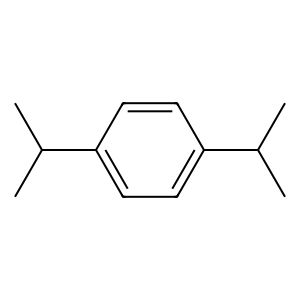
1,4-Diisopropylbenzene
CAS No.:
100-18-5
M. Wt:
162.271
M. Fa:
C12H18
InChI Key:
SPPWGCYEYAMHDT-UHFFFAOYSA-N
Appearance:
Colorless Liquid
Names and Identifiers of 1,4-Diisopropylbenzene
CAS Number |
100-18-5 |
|---|---|
EC Number |
202-826-9 |
MDL Number |
MFCD00008892 |
IUPAC Name |
1,4-di(propan-2-yl)benzene |
InChI |
InChI=1S/C12H18/c1-9(2)11-5-7-12(8-6-11)10(3)4/h5-10H,1-4H3 |
InChIKey |
SPPWGCYEYAMHDT-UHFFFAOYSA-N |
Canonical SMILES |
CC(C)C1=CC=C(C=C1)C(C)C |
UNII |
5M62031NZP |
UNSPSC Code |
12352100 |
Physical and chemical properties of 1,4-Diisopropylbenzene
Boiling Point |
210.3 °C |
|---|---|
BRN |
1854739 |
Density |
0.8568 AT 20 °C/4 °C |
Exact Mass |
162.140854 |
Flash Point |
76.7±0.0 °C |
Index of Refraction |
1.488 |
LogP |
4.90 |
Melting Point |
-17.1 °C |
Molecular Formula |
C12H18 |
Molecular Weight |
162.271 |
Solubility |
Sol in all proportions of alcohol, ether, acetone, benzene. |
Storage condition |
Sealed in dry,Room Temperature |
Vapour density |
5.6 (vs air) |
Vapour Pressure |
1 MM HG AT 40.0 °C |
Water Solubility |
Soluble in alcohol, ether, acetone and benzene. Insoluble in water. |
Safety Information of 1,4-Diisopropylbenzene


Applications of 1,4-Diisopropylbenzene
1,4-Diisopropylbenzene serves as an important chemical intermediate in various industrial applications:
- Production of Stabilizers and Polymers: It is utilized in synthesizing stabilizers for polymers and synthetic lubricants.
- Hydroperoxide Production: The compound is a precursor for hydroperoxides used in radical polymerization processes.
- Chemical Manufacturing: It plays a role in producing various chemicals used in different sectors.
Interaction Studies of 1,4-Diisopropylbenzene
Research indicates that 1,4-diisopropylbenzene can react exothermically with strong oxidizing agents and bases. Its interactions with diazo compounds also yield notable reactions. Substitution at the benzene nucleus occurs readily through halogenation and other electrophilic aromatic substitution reactions. The compound's reactivity underscores its utility in organic synthesis but also necessitates careful handling due to potential hazards.
Physical sample testing spectrum (NMR) of 1,4-Diisopropylbenzene

 Cas:201230-82-2

 Cas:98-82-8

 Cas:71-43-2