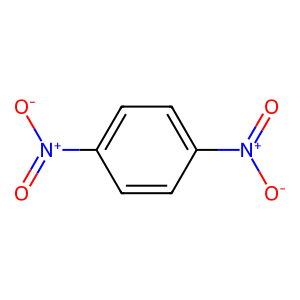
1,4-Dinitrobenzene
CAS No.:
100-25-4
M. Wt:
168.107
M. Fa:
C6H4N2O4
InChI Key:
FYFDQJRXFWGIBS-UHFFFAOYSA-N
Appearance:
Brown powder
Names and Identifiers of 1,4-Dinitrobenzene
CAS Number |
100-25-4 |
|---|---|
EC Number |
202-833-7 |
IUPAC Name |
1,4-dinitrobenzene |
InChI |
InChI=1S/C6H4N2O4/c9-7(10)5-1-2-6(4-3-5)8(11)12/h1-4H |
InChIKey |
FYFDQJRXFWGIBS-UHFFFAOYSA-N |
Canonical SMILES |
C1=CC(=CC=C1[N+](=O)[O-])[N+](=O)[O-] |
UNII |
784Q9O56S9 |
Physical and chemical properties of 1,4-Dinitrobenzene
Boiling Point |
570 °F |
|---|---|
Decomposition |
When heated to decomposition it emits toxic fumes of /nitrogen oxides/. |
Density |
1.63 |
Exact Mass |
168.017105 |
Flash Point |
150 °C |
Index of Refraction |
1.612 |
LogP |
1.46/1.49 |
Melting Point |
343 °F |
Molecular Formula |
C6H4N2O4 |
Molecular Weight |
168.107 |
PSA |
91.64000 |
Solubility |
0.01% |
Stability |
Stable, but may be shock-sensitive. May explode if heated. Incompatible with oxidizing agents, strong bases, nitric acid, many metals, tin oxides. |
Vapour density |
Relative vapor density (air = 1): 5.8 |
Vapour Pressure |
Vapor pressure, kPa at 20 °C: |
Safety Information of 1,4-Dinitrobenzene


Applications of 1,4-Dinitrobenzene
Biological Activity of 1,4-Dinitrobenzene
1,4-Dinitrobenzene exhibits significant biological activity, particularly regarding its toxicity. It has been classified as a potential carcinogen and is known to cause various health effects upon exposure:
- Acute Toxicity: Inhalation or skin contact can lead to symptoms such as dizziness, headache, nausea, and respiratory distress. Prolonged exposure may result in more severe symptoms including cyanosis (blue lips and skin) due to methemoglobinemia.
- Ecotoxicity: The compound is toxic to aquatic life and can cause long-term adverse effects in the environment.
Physical sample testing spectrum (NMR) of 1,4-Dinitrobenzene


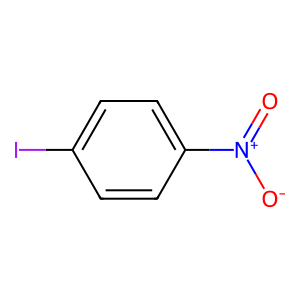 Cas:636-98-6
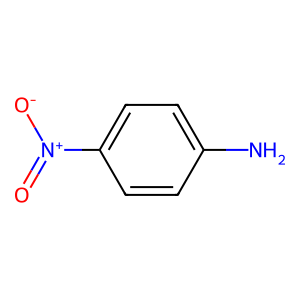 Cas:100-01-6