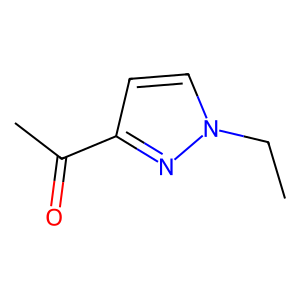
1-(1-ethyl-1H-pyrazol-3-yl)ethanone
CAS No.:
1004193-93-4
M. Wt:
138.16700
M. Fa:
C7H10N2O
InChI Key:
UZGPIUGGVSKCAM-UHFFFAOYSA-N
Appearance:
Yellow Liquid
Names and Identifiers of 1-(1-ethyl-1H-pyrazol-3-yl)ethanone
CAS Number |
1004193-93-4 |
|---|---|
MDL Number |
MFCD04968782 |
IUPAC Name |
1-(1-ethylpyrazol-3-yl)ethanone |
InChI |
InChI=1S/C7H10N2O/c1-3-9-5-4-7(8-9)6(2)10/h4-5H,3H2,1-2H3 |
InChIKey |
UZGPIUGGVSKCAM-UHFFFAOYSA-N |
Canonical SMILES |
CCN1C=CC(=N1)C(=O)C |
UNSPSC Code |
12352100 |
Physical and chemical properties of 1-(1-ethyl-1H-pyrazol-3-yl)ethanone
Density |
1.08 |
|---|---|
Exact Mass |
138.07900 |
LogP |
1.10560 |
Molecular Formula |
C7H10N2O |
Molecular Weight |
138.16700 |
PSA |
34.89000 |
Safety Information of 1-(1-ethyl-1H-pyrazol-3-yl)ethanone

Applications of 1-(1-ethyl-1H-pyrazol-3-yl)ethanone
1-(1-ethyl-1H-pyrazol-3-yl)ethanone has several notable applications:
- Pharmaceutical Development: It serves as a building block in the synthesis of more complex pharmaceutical compounds.
- Research Tool: Utilized in biochemical studies to explore enzyme interactions and biological pathways.
- Agricultural Chemistry: Investigated for potential use in developing agrochemicals due to its biological activity.
Interaction Studies of 1-(1-ethyl-1H-pyrazol-3-yl)ethanone
Interaction studies involving 1-(1-ethyl-1H-pyrazol-3-yl)ethanone focus on its binding affinity and effects on various biological targets. These studies typically assess:
- Enzyme Inhibition: Evaluating how the compound affects enzyme activity related to metabolic pathways.
- Receptor Binding: Investigating interactions with specific receptors that may lead to physiological responses.
These studies are crucial for understanding the compound's mechanism of action and potential therapeutic uses.
Biological Activity of 1-(1-ethyl-1H-pyrazol-3-yl)ethanone
The biological activity of 1-(1-ethyl-1H-pyrazol-3-yl)ethanone has been the subject of research due to its potential therapeutic properties. Studies suggest that compounds with pyrazole structures can exhibit:
- Antimicrobial Activity: Some derivatives have shown effectiveness against various bacterial strains.
- Anti-inflammatory Properties: Research indicates potential in modulating inflammatory pathways.
- Cytotoxic Effects: Certain studies have explored its ability to induce apoptosis in cancer cells.
The specific mechanisms of action are still under investigation, but they likely involve interactions with biological targets such as enzymes or receptors involved in these pathways.
Physical sample testing spectrum (NMR) of 1-(1-ethyl-1H-pyrazol-3-yl)ethanone
