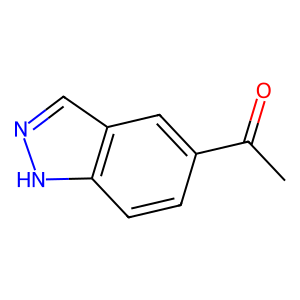
1-(1H-Indazol-5-yl)ethanone
Names and Identifiers of 1-(1H-Indazol-5-yl)ethanone
CAS Number |
1001906-63-3 |
|---|---|
EC Number |
841-728-6 |
MDL Number |
MFCD11869763 |
IUPAC Name |
1-(1H-indazol-5-yl)ethanone |
InChI |
InChI=1S/C9H8N2O/c1-6(12)7-2-3-9-8(4-7)5-10-11-9/h2-5H,1H3,(H,10,11) |
InChIKey |
WYLOAPVBIBQLJT-UHFFFAOYSA-N |
Canonical SMILES |
CC(=O)C1=CC2=C(C=C1)NN=C2 |
UNSPSC Code |
12352100 |
Physical and chemical properties of 1-(1H-Indazol-5-yl)ethanone
Acidity coefficient |
12.77±0.40(Predicted) |
|---|---|
Boiling Point |
348.8ºC at 760 mmHg |
Density |
1.264 g/cm3 |
Exact Mass |
160.06400 |
Flash Point |
168.8ºC |
LogP |
1.76550 |
Molecular Formula |
C9H8N2O |
Molecular Weight |
160.17300 |
PSA |
45.75000 |
Storage condition |
Sealed in dry,Room Temperature |
Safety Information of 1-(1H-Indazol-5-yl)ethanone

Applications of 1-(1H-Indazol-5-yl)ethanone
1-(1H-Indazol-5-yl)ethanone finds applications primarily in medicinal chemistry as a precursor for synthesizing various bioactive compounds. Its derivatives are investigated for their potential therapeutic effects against cancer, inflammation, and microbial infections. The unique structural features of this compound allow for modifications that can enhance its biological activity and selectivity.
Interaction Studies of 1-(1H-Indazol-5-yl)ethanone
Interaction studies involving 1-(1H-Indazol-5-yl)ethanone often focus on its binding affinity to biological targets such as enzymes or receptors. For example, computational docking studies have shown that certain derivatives can effectively bind to target proteins involved in disease pathways, demonstrating potential inhibitory effects. These studies utilize techniques like molecular dynamics simulations and binding energy calculations to predict interaction strength and specificity.
Biological Activity of 1-(1H-Indazol-5-yl)ethanone
The biological activity of 1-(1H-Indazol-5-yl)ethanone and its derivatives has been explored in several studies. Indazole derivatives are known for their diverse pharmacological properties, including anti-inflammatory, anti-tumor, and antimicrobial activities. Specifically, compounds containing the indazole structure have shown promise in inhibiting key enzymes such as monoamine oxidase B and nitric oxide synthase, making them relevant in the treatment of neurological disorders.
Physical sample testing spectrum (NMR) of 1-(1H-Indazol-5-yl)ethanone

 Cas:61700-61-6

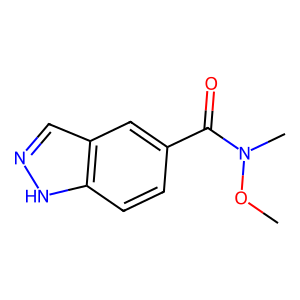 Cas:1093306-90-1

 Cas:676-58-4
 Cas:877264-73-8