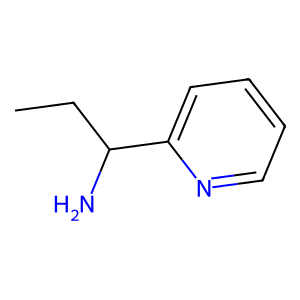
1-(2-Pyridyl)-1-propylamine
CAS No.:
100155-73-5
M. Wt:
136.19400
M. Fa:
C8H12N2
InChI Key:
ARIBPNACTHQUIK-UHFFFAOYSA-N
Appearance:
Yellow Liquid
Names and Identifiers of 1-(2-Pyridyl)-1-propylamine
CAS Number |
100155-73-5 |
|---|---|
MDL Number |
MFCD09802324 |
IUPAC Name |
1-pyridin-2-ylpropan-1-amine |
InChI |
InChI=1S/C8H12N2/c1-2-7(9)8-5-3-4-6-10-8/h3-7H,2,9H2,1H3 |
InChIKey |
ARIBPNACTHQUIK-UHFFFAOYSA-N |
Canonical SMILES |
CCC(C1=CC=CC=N1)N |
UNSPSC Code |
12352100 |
Physical and chemical properties of 1-(2-Pyridyl)-1-propylamine
Acidity coefficient |
9.02±0.39(Predicted) |
|---|---|
Boiling Point |
214.13ºC at 760 mmHg |
Density |
0.998g/cm3 |
Exact Mass |
136.10000 |
Flash Point |
103.931ºC |
Index of Refraction |
1.529 |
LogP |
2.19170 |
Melting Point |
57 °C |
Molecular Formula |
C8H12N2 |
Molecular Weight |
136.19400 |
PSA |
38.91000 |
Storage condition |
under inert gas (nitrogen or Argon) at 2–8 °C |
Vapour Pressure |
0.158mmHg at 25°C |
Safety Information of 1-(2-Pyridyl)-1-propylamine

Applications of 1-(2-Pyridyl)-1-propylamine
1-(2-Pyridyl)-1-propylamine finds applications in various domains:
- Pharmaceuticals: It serves as an intermediate in the synthesis of pharmaceuticals, particularly those targeting neurological or allergic conditions.
- Catalysis: Its derivatives are used as ligands in catalytic processes, enhancing reaction selectivity and efficiency.
- Research: The compound is utilized in academic research to explore new synthetic methodologies and biological interactions.
Biological Activity of 1-(2-Pyridyl)-1-propylamine
The biological activity of 1-(2-Pyridyl)-1-propylamine has been explored in various studies. It has shown potential as:
- Antihistaminic Agent: Similar compounds have been investigated for their antihistaminic properties, making this compound a candidate for further research in allergy treatments.
- Ligand in Catalysis: Its derivatives are being studied as ligands in asymmetric catalysis, which can control the stereochemical outcomes of reactions.
Physical sample testing spectrum (NMR) of 1-(2-Pyridyl)-1-propylamine

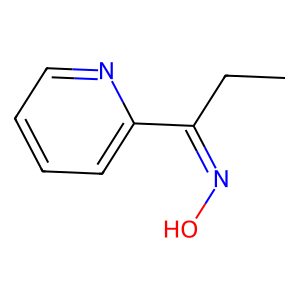 Cas:108018-18-4
