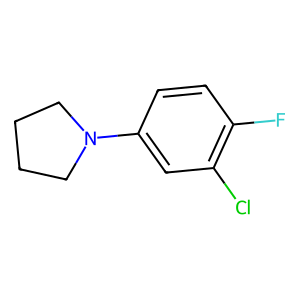
1-(3-Chloro-4-fluorophenyl)pyrrolidine
Names and Identifiers of 1-(3-Chloro-4-fluorophenyl)pyrrolidine
CAS Number |
1000339-33-2 |
|---|---|
MDL Number |
MFCD09878399 |
IUPAC Name |
1-(3-chloro-4-fluorophenyl)pyrrolidine |
InChI |
InChI=1S/C10H11ClFN/c11-9-7-8(3-4-10(9)12)13-5-1-2-6-13/h3-4,7H,1-2,5-6H2 |
InChIKey |
RYEWSNZSVSTBSF-UHFFFAOYSA-N |
Canonical SMILES |
C1CCN(C1)C2=CC(=C(C=C2)F)Cl |
UNSPSC Code |
12352100 |
Physical and chemical properties of 1-(3-Chloro-4-fluorophenyl)pyrrolidine
Exact Mass |
199.05600 |
|---|---|
H Bond Acceptors |
1 |
H Bond Donors |
0 |
LogP |
3.14430 |
Molecular Formula |
C10H11ClFN |
Molecular Weight |
199.65200 |
PSA |
3.24000 |
Storage condition |
2-8°C |
Safety Information of 1-(3-Chloro-4-fluorophenyl)pyrrolidine

Applications of 1-(3-Chloro-4-fluorophenyl)pyrrolidine
1-(3-Chloro-4-fluorophenyl)pyrrolidine has diverse applications across multiple domains:
- Medicinal Chemistry: It is explored as a potential drug candidate due to its biological activity.
- Organic Synthesis: The compound serves as a building block for synthesizing more complex molecules.
- Industrial Use: It is utilized in producing specialty chemicals and intermediates for various applications.
Interaction Studies of 1-(3-Chloro-4-fluorophenyl)pyrrolidine
Studies focusing on the interactions of 1-(3-Chloro-4-fluorophenyl)pyrrolidine with biological targets have revealed insights into its mechanism of action. The compound may inhibit or activate specific enzymes or receptors, leading to various biochemical effects. Understanding these interactions is crucial for evaluating its therapeutic potential and safety profile.
Biological Activity of 1-(3-Chloro-4-fluorophenyl)pyrrolidine
Research indicates that 1-(3-Chloro-4-fluorophenyl)pyrrolidine exhibits significant biological activity, particularly in the context of drug development. Its interaction with specific molecular targets, such as enzymes or receptors, suggests potential therapeutic applications. The compound's ability to modulate biological pathways makes it a candidate for further investigation in pharmacology.