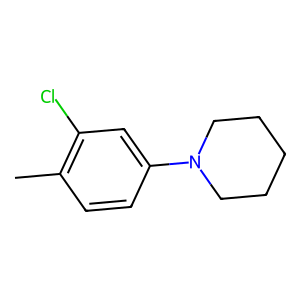
1-(3-Chloro-4-methylphenyl)piperidine
Names and Identifiers of 1-(3-Chloro-4-methylphenyl)piperidine
CAS Number |
1000339-31-0 |
|---|---|
MDL Number |
MFCD09878387 |
IUPAC Name |
1-(3-chloro-4-methylphenyl)piperidine |
InChI |
InChI=1S/C12H16ClN/c1-10-5-6-11(9-12(10)13)14-7-3-2-4-8-14/h5-6,9H,2-4,7-8H2,1H3 |
InChIKey |
BVTFSKQEMUXBLP-UHFFFAOYSA-N |
Canonical SMILES |
CC1=C(C=C(C=C1)N2CCCCC2)Cl |
UNSPSC Code |
12352100 |
Physical and chemical properties of 1-(3-Chloro-4-methylphenyl)piperidine
Exact Mass |
209.09700 |
|---|---|
H Bond Acceptors |
1 |
H Bond Donors |
0 |
LogP |
3.70370 |
Molecular Formula |
C12H16ClN |
Molecular Weight |
209.71500 |
PSA |
3.24000 |
Storage condition |
2-8°C |
Safety Information of 1-(3-Chloro-4-methylphenyl)piperidine

Applications of 1-(3-Chloro-4-methylphenyl)piperidine
1-(3-Chloro-4-methylphenyl)piperidine has various applications across multiple fields:
- Chemical Synthesis: It serves as an intermediate in the synthesis of more complex organic molecules.
- Pharmaceutical Development: Ongoing research explores its potential for developing new drugs targeting specific diseases.
- Specialty Chemicals: The compound is utilized in producing specialty chemicals and as a building block for synthesizing other compounds.
Interaction Studies of 1-(3-Chloro-4-methylphenyl)piperidine
Interaction studies focus on how 1-(3-Chloro-4-methylphenyl)piperidine interacts with various biomolecules. These studies aim to elucidate its mechanism of action at the molecular level, including binding affinities to target enzymes or receptors. Understanding these interactions is crucial for optimizing the compound for therapeutic use.
Biological Activity of 1-(3-Chloro-4-methylphenyl)piperidine
Research indicates that 1-(3-Chloro-4-methylphenyl)piperidine exhibits significant biological activity. It has been studied for its potential effects on various biological pathways, particularly in pharmacology. The compound may interact with specific receptors or enzymes, modulating their activity and leading to various physiological effects. Its biological activity is under investigation for potential therapeutic applications, including roles in neuropharmacology and cancer treatment.