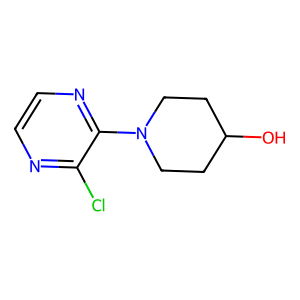
1-(3-Chloropyrazin-2-yl)piperidin-4-ol
CAS No.:
1248111-06-9
M. Wt:
213.66
M. Fa:
C9H12ClN3O
InChI Key:
SOASMJHVAOIYFU-UHFFFAOYSA-N
Names and Identifiers of 1-(3-Chloropyrazin-2-yl)piperidin-4-ol
CAS Number |
1248111-06-9 |
|---|---|
MDL Number |
MFCD16079924 |
IUPAC Name |
1-(3-chloropyrazin-2-yl)piperidin-4-ol |
InChI |
InChI=1S/C9H12ClN3O/c10-8-9(12-4-3-11-8)13-5-1-7(14)2-6-13/h3-4,7,14H,1-2,5-6H2 |
InChIKey |
SOASMJHVAOIYFU-UHFFFAOYSA-N |
Canonical SMILES |
C1CN(CCC1O)C2=NC=CN=C2Cl |
UNSPSC Code |
12352100 |
Physical and chemical properties of 1-(3-Chloropyrazin-2-yl)piperidin-4-ol
H Bond Acceptors |
4 |
|---|---|
H Bond Donors |
1 |
LogP |
0.382683796666666 |
Molecular Formula |
C9H12ClN3O |
Molecular Weight |
213.66 |
Safety Information of 1-(3-Chloropyrazin-2-yl)piperidin-4-ol

Applications of 1-(3-Chloropyrazin-2-yl)piperidin-4-ol
This compound has potential applications across several fields:
- Pharmaceutical Development: Its role as a phosphodiesterase inhibitor makes it a candidate for developing drugs targeting cardiovascular diseases and cancer.
- Research Tool: It can serve as a model compound in studies focusing on the structure-activity relationship of piperidine derivatives.
Interaction Studies of 1-(3-Chloropyrazin-2-yl)piperidin-4-ol
Interaction studies involving 1-(3-Chloropyrazin-2-yl)piperidin-4-ol have highlighted its ability to bind selectively to certain biological targets. Notably:
- Molecular Docking Studies: These studies suggest that the compound can effectively interact with specific enzyme active sites, potentially leading to significant pharmacological effects.
- ADMET Profiling: Assessment of Absorption, Distribution, Metabolism, Excretion, and Toxicity profiles indicates favorable characteristics for drug development.
Biological Activity of 1-(3-Chloropyrazin-2-yl)piperidin-4-ol
1-(3-Chloropyrazin-2-yl)piperidin-4-ol exhibits significant biological activity, particularly as an inhibitor of phosphodiesterase enzymes. This inhibition is crucial for various therapeutic applications, including:
- Anticancer Activity: Studies indicate that compounds with similar structures have shown cytotoxic effects against various cancer cell lines.
- Neuropharmacological Effects: Due to its ability to cross the blood-brain barrier, it may have implications in treating neurological disorders.