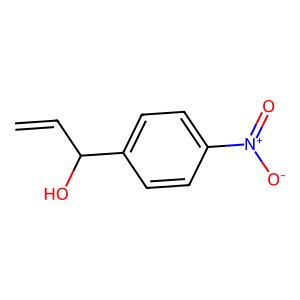
1-(4-Nitrophenyl)prop-2-en-1-ol
Names and Identifiers of 1-(4-Nitrophenyl)prop-2-en-1-ol
CAS Number |
123232-63-3 |
|---|---|
IUPAC Name |
1-(4-nitrophenyl)prop-2-en-1-ol |
InChI |
InChI=1S/C9H9NO3/c1-2-9(11)7-3-5-8(6-4-7)10(12)13/h2-6,9,11H,1H2 |
InChIKey |
GZYWUWDTKLRMKY-UHFFFAOYSA-N |
Canonical SMILES |
C=CC(C1=CC=C(C=C1)[N+](=O)[O-])O |
Physical and chemical properties of 1-(4-Nitrophenyl)prop-2-en-1-ol
Boiling Point |
328.2ºC at 760mmHg |
|---|---|
Density |
1.244g/cm3 |
Exact Mass |
179.05800 |
Flash Point |
145.5ºC |
Index of Refraction |
1.585 |
LogP |
2.33740 |
Molecular Formula |
C9H9NO3 |
Molecular Weight |
179.17300 |
PSA |
66.05000 |
Vapour Pressure |
7.77E-05mmHg at 25°C |
Applications of 1-(4-Nitrophenyl)prop-2-en-1-ol
1-(4-Nitrophenyl)prop-2-en-1-ol has diverse applications across various fields:
- Chemistry: Used as a building block for synthesizing more complex organic molecules and studying nonlinear optical properties.
- Biology: Investigated for potential use in developing antimicrobial and anti-inflammatory agents.
- Medicine: Explored for its role in designing new therapeutic agents.
- Industry: Employed in producing specialty chemicals and materials, including polymers and coatings .
These applications underscore its significance in both research and commercial sectors.
Interaction Studies of 1-(4-Nitrophenyl)prop-2-en-1-ol
The interaction studies of 1-(4-Nitrophenyl)prop-2-en-1-ol focus on its mechanism of action at the molecular level. For instance, its antimicrobial activity may involve disrupting bacterial cell membranes or inhibiting key enzymes necessary for bacterial survival. Additionally, its anti-inflammatory properties could be linked to modulating signaling pathways that regulate inflammation, thereby influencing cytokine production .
Biological Activity of 1-(4-Nitrophenyl)prop-2-en-1-ol
Research indicates that 1-(4-Nitrophenyl)prop-2-en-1-ol exhibits potential biological activities:
- Antimicrobial Properties: It has been investigated for its ability to inhibit bacterial growth, potentially disrupting cell membranes or inhibiting essential enzymes.
- Anti-inflammatory Effects: The compound may influence signaling pathways associated with inflammation, possibly by inhibiting pro-inflammatory cytokines .
These properties make it a candidate for further exploration in drug development and therapeutic applications.
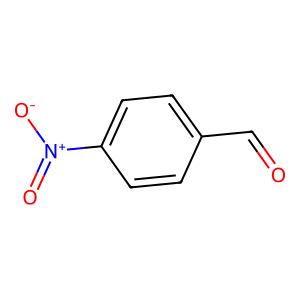 Cas:555-16-8

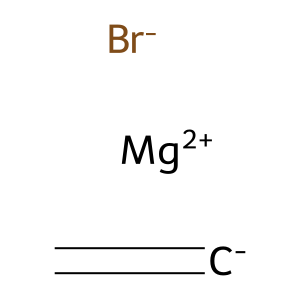 Cas:1826-67-1

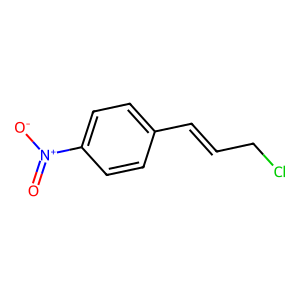 Cas:71269-07-3