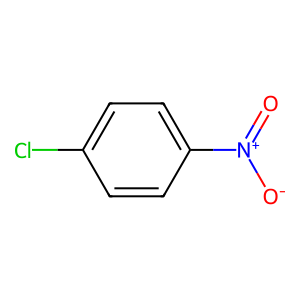
1-Chloro-4-nitrobenzene
Names and Identifiers of 1-Chloro-4-nitrobenzene
CAS Number |
100-00-5 |
|---|---|
EC Number |
202-809-6 |
MDL Number |
MFCD00007285 |
IUPAC Name |
1-chloro-4-nitrobenzene |
InChI |
InChI=1S/C6H4ClNO2/c7-5-1-3-6(4-2-5)8(9)10/h1-4H |
InChIKey |
CZGCEKJOLUNIFY-UHFFFAOYSA-N |
Canonical SMILES |
C1=CC(=CC=C1[N+](=O)[O-])Cl |
UNII |
CVL66U249D |
UNSPSC Code |
12352100 |
Physical and chemical properties of 1-Chloro-4-nitrobenzene
Boiling Point |
468 °F |
|---|---|
Decomposition |
...WHEN HEATED TO DECOMPOSITION IT EMITS VERYY TOXIC FUMES OF /NITROGEN OXIDES AND HYDROGEN CHLORIDE./ |
Density |
1.52 |
Flash Point |
261 °F |
Index of Refraction |
MAX ABSORPTION (METHANOL): 270.5 NM (LOG E= 4.03); SADTLER REF NUMBER: 4683 (IR, PRISM); 435 (IR, GRATING); INDEX OF REFRACTION: 1.5376 AT 100 °C/ALPHA |
LogP |
2.39 |
Melting Point |
182 °F |
Molecular Formula |
C6H4ClNO2 |
Molecular Weight |
157.55 |
Odor |
Sweet odor |
Solubility |
Slight |
Vapour density |
5.44 |
Vapour Pressure |
(86 °F): 0.2 mmHg |
Safety Information of 1-Chloro-4-nitrobenzene


Applications of 1-Chloro-4-nitrobenzene
1-Chloro-4-nitrobenzene serves as a crucial intermediate in the production of various chemicals:
- Synthesis of Dyes and Pigments: It is used in manufacturing azo dyes and other colorants.
- Production of Pharmaceuticals: The compound is involved in synthesizing active pharmaceutical ingredients due to its reactive functional groups.
- Rubber Industry: It acts as an antioxidant in rubber formulations, improving durability and performance.
Interaction Studies of 1-Chloro-4-nitrobenzene
Studies on the interactions of 1-chloro-4-nitrobenzene with biological systems reveal its potential for toxicity. Its metabolites have been shown to cause oxidative stress and damage to cellular components. Research indicates that exposure can lead to significant metabolic changes in liver cells, implicating cytochrome P450 enzymes in its biotransformation processes.
Furthermore, assessments have demonstrated that this compound may exhibit immunotoxic effects following both acute and chronic exposure scenarios.
Biological Activity of 1-Chloro-4-nitrobenzene
1-Chloro-4-nitrobenzene exhibits notable biological activity, particularly concerning its toxicity and potential carcinogenic effects. It has been shown to induce methaemoglobin formation and oxidative damage to red blood cells, leading to regenerative anemia in animal studies. In vitro studies indicate that it can induce chromosomal aberrations and sister chromatid exchanges at high doses, suggesting genotoxicity.
The compound is metabolized in mammals primarily through three pathways: reduction of the nitro group, displacement of the chloride ion via glutathione conjugation, and ring hydroxylation. Metabolites such as 4-chloroaniline have been identified as significant products of this metabolism, contributing to its toxicological profile.
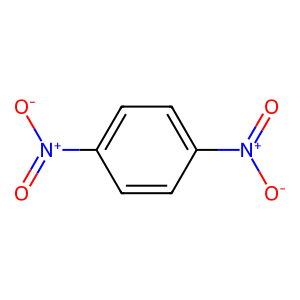 Cas:100-25-4

 Cas:7782-50-5

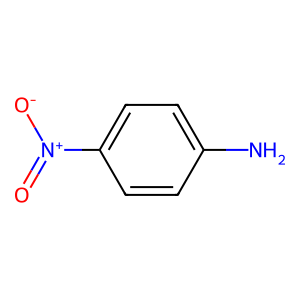 Cas:100-01-6
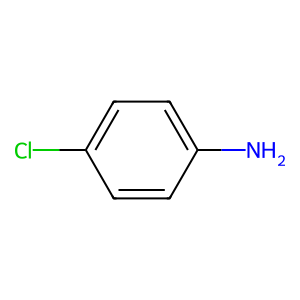 Cas:106-47-8