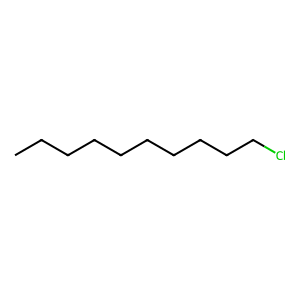
1-Chlorodecane
CAS No.:
1002-69-3
M. Wt:
176.727
M. Fa:
C10H21Cl
InChI Key:
ZTEHOZMYMCEYRM-UHFFFAOYSA-N
Appearance:
Colorless Liquid
Names and Identifiers of 1-Chlorodecane
CAS Number |
1002-69-3 |
|---|---|
EC Number |
213-691-0 |
MDL Number |
MFCD00000956 |
IUPAC Name |
1-chlorodecane |
InChI |
InChI=1S/C10H21Cl/c1-2-3-4-5-6-7-8-9-10-11/h2-10H2,1H3 |
InChIKey |
ZTEHOZMYMCEYRM-UHFFFAOYSA-N |
Canonical SMILES |
CCCCCCCCCCCl |
UNII |
L0HSC44E5X |
UNSPSC Code |
12352100 |
Physical and chemical properties of 1-Chlorodecane
Boiling Point |
223.7±3.0 °C at 760 mmHg |
|---|---|
BRN |
1735224 |
Density |
0.9±0.1 g/cm3 |
Exact Mass |
176.133179 |
Flash Point |
83.3±0.0 °C |
Index of Refraction |
1.433 |
LogP |
5.75 |
Melting Point |
−34 °C(lit.) |
Molecular Formula |
C10H21Cl |
Molecular Weight |
176.727 |
Solubility |
0.01g/l |
Storage condition |
-20°C |
Vapour Pressure |
0.1±0.4 mmHg at 25°C |
Water Solubility |
0.01 g/L (20 ºC) |
Solubility of 1-Chlorodecane
| Solvent | Dissolution Phenomenon | Temperature Effect | pH Effect |
|---|---|---|---|
| Water (H₂O) | Almost insoluble (slightly soluble) | Solubility increases slightly with rising temperature | No significant effect (stable under neutral conditions) |
| Ethanol | Soluble (partially miscible) | Solubility increases with rising temperature | Stable under acidic or basic conditions, no obvious hydrolysis |
| Acetone | Readily soluble | Solubility increases with rising temperature | No obvious effect |
| Diethyl ether | Readily soluble | Solubility increases with rising temperature | No significant effect |
| Benzene | Readily soluble | Solubility increases with rising temperature | No effect |
| Toluene | Readily soluble | Solubility increases with rising temperature | No effect |
| Chloroform (CHCl₃) | Readily soluble | Solubility increases with rising temperature | No effect |
| Dichloromethane (DCM) | Readily soluble | Solubility increases with rising temperature | No effect |
| n-Hexane | Readily soluble | Solubility increases with rising temperature | No effect |
| Ethyl acetate | Readily soluble | Solubility increases with rising temperature | No effect |
Safety Information of 1-Chlorodecane


Key Milestone of 1-Chlorodecane
| Time (Year) | Event/Milestone | Context/Significance |
|---|---|---|
| Approx. Late 19th Century - Early 20th Century | Synthesized as one of the long-chain halogenated alkanes series | During the early development of organic chemistry, long-chain aliphatic halohydrocarbons (e.g., chloroalkanes) were systematically synthesized via reactions of alcohols with chlorinating agents (e.g., SOCl₂, PCl₃). 1-Chlorodecane, as a C10 straight-chain chloroalkane, was included in this research scope. |
| 1930s–1950s | Explored as an intermediate for surfactants and lubricants | With the rise of the petrochemical industry, long-chain alkyl halides were used as precursors for synthesizing surfactants like quaternary ammonium salts, amines, and thiols. Due to its moderate chain length, 1-chlorodecane was used in laboratories and small-scale industry for preparing functional molecules. |
| 1960s–1970s | Widely used as an alkylating agent in organic synthesis | Owing to its good electrophilicity and stability, 1-chlorodecane was extensively used for alkylation reactions of heteroatoms (N-, O-, S-, etc.), becoming a common laboratory reagent. |
| 1980s–1990s | Used as a standard and calibration substance in Gas Chromatography (GC) analysis | Due to its well-defined boiling point (approx. 223–225°C) and chromatographic behavior, 1-chlorodecane was employed as a standard substance for determining Gas Chromatography retention indices (e.g., Kováts index), especially in the analysis of long-chain hydrocarbon mixtures. |
| 2000s - Present | Used as a model molecule in nanomaterials and Self-Assembled Monolayers (SAMs) research | 1-Chlorodecane serves as a precursor for preparing thiol or silane derivatives, which are then used to construct ordered monomolecular films. In materials science, it is used to modulate surface wettability or as a hydrophobic layer building block. |
| 2010s - Present | Incorporated into chemical safety and environmental assessment frameworks | With the implementation of regulations like REACH (EU), the toxicological, ecotoxicological, and biodegradability data of 1-chlorodecane have been systematically assessed, promoting safety usage guidelines in its industrial applications. |
Applications of 1-Chlorodecane
1-Chlorodecane has several applications in various fields:
- Solvent: It is used as a solvent in organic synthesis due to its ability to dissolve many organic compounds.
- Intermediate in Organic Synthesis: The compound serves as an important intermediate in the synthesis of surfactants, pharmaceuticals, and other chemical products.
- Chemical Research: It is utilized in laboratories for research purposes, particularly in studies involving alkyl halides and their reactivity.
Interaction Studies of 1-Chlorodecane
While specific interaction studies involving 1-chlorodecane are scarce, it is essential to consider its interactions with biological systems and other chemicals. As an alkyl halide, it may interact with nucleophiles in biological environments, potentially leading to toxicological effects. Research into similar compounds has highlighted concerns regarding the environmental persistence and bioaccumulation potential of chlorinated hydrocarbons.
Physical sample testing spectrum (NMR) of 1-Chlorodecane

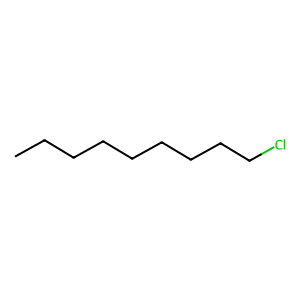 Cas:2473-01-0

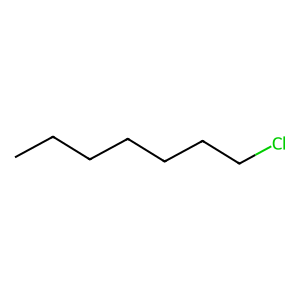 Cas:629-06-1
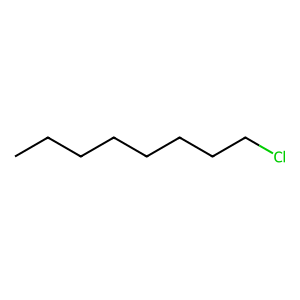 Cas:111-85-3