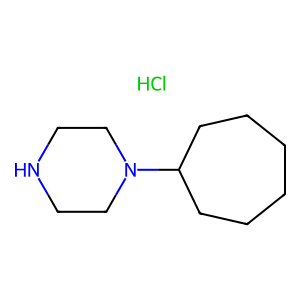
1-Cycloheptyl-piperazine hydrochloride
Names and Identifiers of 1-Cycloheptyl-piperazine hydrochloride
CAS Number |
436099-91-1 |
|---|---|
IUPAC Name |
1-cycloheptylpiperazine;hydrochloride |
InChI |
InChI=1S/C11H22N2.ClH/c1-2-4-6-11(5-3-1)13-9-7-12-8-10-13;/h11-12H,1-10H2;1H |
InChIKey |
AGICGXYJQOVNRL-UHFFFAOYSA-N |
Canonical SMILES |
C1CCCC(CC1)N2CCNCC2.Cl |
Physical and chemical properties of 1-Cycloheptyl-piperazine hydrochloride
Boiling Point |
268.4ºC at 760mmHg |
|---|---|
Exact Mass |
218.15500 |
Flash Point |
102.8ºC |
LogP |
2.68310 |
Molecular Formula |
C11H23ClN2 |
Molecular Weight |
218.76700 |
PSA |
15.27000 |
Applications of 1-Cycloheptyl-piperazine hydrochloride
1-Cycloheptyl-piperazine hydrochloride finds applications in various fields:
- Pharmaceuticals: Due to its sigma receptor activity, it is being explored for potential use in developing treatments for psychiatric disorders.
- Material Science: The compound can be utilized in synthesizing novel luminescent materials and organic light-emitting diodes (OLEDs) due to its photoluminescent properties.
- Research: It serves as a valuable tool in biochemical studies focused on receptor-ligand interactions.
Interaction Studies of 1-Cycloheptyl-piperazine hydrochloride
Studies have shown that 1-cycloheptyl-piperazine hydrochloride interacts with sigma receptors, influencing neurotransmitter release and modulating various signaling pathways in the brain. This interaction is crucial for understanding its therapeutic potential and guiding future research towards specific clinical applications.
Biological Activity of 1-Cycloheptyl-piperazine hydrochloride
The compound exhibits significant biological activity, particularly as a ligand for sigma receptors (σ1 and σ2). These receptors are implicated in various neurological processes, making 1-cycloheptyl-piperazine hydrochloride a candidate for therapeutic applications in treating disorders such as depression and anxiety. Its interaction with sigma receptors suggests potential neuroprotective effects, although further studies are necessary to elucidate its full pharmacological profile.