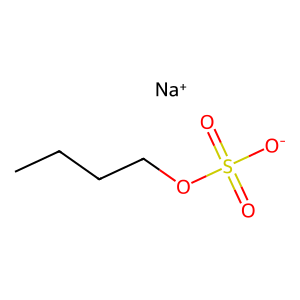
Sulfuric acid, monobutyl ester, sodium salt
Names and Identifiers of 1000-67-5
CAS Number |
1000-67-5 |
|---|---|
EC Number |
213-672-7 |
IUPAC Name |
sodium;butyl sulfate |
InChI |
InChI=1S/C4H10O4S.Na/c1-2-3-4-8-9(5,6)7;/h2-4H2,1H3,(H,5,6,7);/q;+1/p-1 |
InChIKey |
NGDIAZZSCVVCEW-UHFFFAOYSA-M |
Canonical SMILES |
CCCCOS(=O)(=O)[O-].[Na+] |
UNII |
BYG89M88BJ |
Physical and chemical properties of 1000-67-5
Exact Mass |
176.01200 |
|---|---|
LogP |
1.34410 |
Melting Point |
>197°C (dec.) |
Molecular Formula |
C4H9NaO4S |
Molecular Weight |
176.16700 |
PSA |
74.81000 |
Solubility |
Methanol (Slightly), Water (Slightly) |
Stability |
Hygroscopic |
Storage condition |
Hygroscopic, Refrigerator, under inert atmosphere |
Applications of 1000-67-5
Sodium butyl sulfate finds diverse applications across various fields:
- Wetting Agent: Used in the mercerization process of cotton to enhance fiber strength and luster.
- Polymerization Catalyst: Acts as a co-catalyst in the polymerization of tetrahydrofuran, facilitating the production of poly(tetrahydrofuran).
- Analytical Chemistry: Employed in high-performance liquid chromatography for separation and analysis purposes.
Interaction Studies of 1000-67-5
Research indicates that sodium butyl sulfate can interact with various biological molecules and processes due to its surfactant characteristics. Its ability to modulate solubility can influence pharmacokinetics, impacting drug delivery systems and cellular uptake mechanisms. Studies have shown that it can affect the metabolism of xenobiotics, further highlighting its potential role in biochemical pathways.
Biological Activity of 1000-67-5
Sodium butyl sulfate exhibits significant biological activity primarily due to its surfactant properties. It enhances the solubility of various compounds in aqueous solutions, which can influence drug metabolism and bioavailability. The compound's amphiphilic nature allows it to interact with cellular membranes and biological molecules, potentially affecting various biochemical pathways.
Mode of ActionThe mechanism of action involves the interaction of the polar sulfate group with water molecules and the nonpolar butyl chain with hydrophobic substances. This property aids in reducing surface tension, promoting wetting and emulsification processes.