![structure of Ethyl 5-Aminoimidazo[1,2-a]pyridine-2-carboxylate](https://molwiki.oss-cn-hongkong.aliyuncs.com/structure/97/1000017-97-9.svg)
Ethyl 5-Aminoimidazo[1,2-a]pyridine-2-carboxylate
Names and Identifiers of 1000017-97-9
CAS Number |
1000017-97-9 |
|---|---|
MDL Number |
MFCD09842618 |
IUPAC Name |
ethyl 5-aminoimidazo[1,2-a]pyridine-2-carboxylate |
InChI |
InChI=1S/C10H11N3O2/c1-2-15-10(14)7-6-13-8(11)4-3-5-9(13)12-7/h3-6H,2,11H2,1H3 |
InChIKey |
SDHJUHBOHSJBEH-UHFFFAOYSA-N |
Canonical SMILES |
CCOC(=O)C1=CN2C(=N1)C=CC=C2N |
UNSPSC Code |
12352100 |
Physical and chemical properties of 1000017-97-9
Acidity coefficient |
5.46±0.50(Predicted) |
|---|---|
Density |
1.4±0.1 g/cm3 |
Exact Mass |
205.085129 |
Index of Refraction |
1.638 |
LogP |
1.11 |
Melting Point |
216-218℃ |
Molecular Formula |
C10H11N3O2 |
Molecular Weight |
205.213 |
PSA |
69.62000 |
Storage condition |
2-8°C |
Safety Information of 1000017-97-9

Applications of 1000017-97-9
Ethyl 5-Aminoimidazo[1,2-a]pyridine-2-carboxylate has several potential applications:
- Pharmaceutical Development: Its unique structure allows for exploration as a lead compound in drug discovery programs targeting inflammation and cancer.
- Biochemical Research: It serves as a useful reagent for studying biological processes and enzyme interactions due to its ability to modify biomolecules.
- Synthetic Chemistry: Used as an intermediate in the synthesis of more complex heterocyclic compounds.
Interaction Studies of 1000017-97-9
Studies on Ethyl 5-Aminoimidazo[1,2-a]pyridine-2-carboxylate's interactions with biological macromolecules are essential for understanding its pharmacological profile. Preliminary data suggest that it may bind to certain proteins or enzymes, influencing their activity. Further research involving binding assays and structural biology techniques (e.g., X-ray crystallography) is necessary to clarify these interactions.
Biological Activity of 1000017-97-9
Research indicates that Ethyl 5-Aminoimidazo[1,2-a]pyridine-2-carboxylate exhibits various biological activities. It has been studied for its potential as an anti-inflammatory agent and has shown activity against certain cancer cell lines. The compound's structure suggests possible interactions with enzymes or receptors involved in these biological pathways, although specific mechanisms remain to be fully elucidated.
Physical sample testing spectrum (NMR) of 1000017-97-9

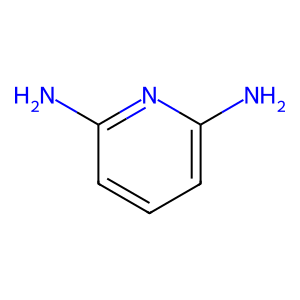 Cas:141-86-6

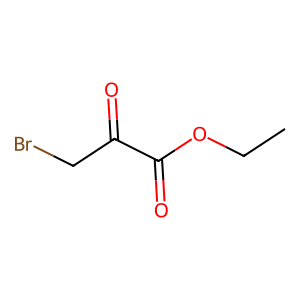 Cas:70-23-5
