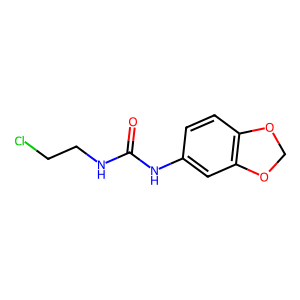
1-(1,3-Benzodioxol-5-yl)-3-(2-chloroethyl)urea
Names and Identifiers of 1000018-00-7
CAS Number |
1000018-00-7 |
|---|---|
IUPAC Name |
1-(1,3-benzodioxol-5-yl)-3-(2-chloroethyl)urea |
Canonical SMILES |
C1OC2=C(O1)C=C(C=C2)NC(=O)NCCCl |
Physical and chemical properties of 1000018-00-7
Molecular Formula |
C10H11ClN2O3 |
|---|---|
Molecular Weight |
242.66 |
Applications of 1000018-00-7
1-(2H-1,3-benzodioxol-5-yl)-3-(2-chloroethyl)urea has potential applications in:
- Pharmaceuticals: As a candidate for anti-inflammatory and anticancer drugs.
- Chemical Research: As a building block for synthesizing more complex organic compounds.
- Agriculture: Potentially as a herbicide or pesticide due to its chemical properties.
Interaction Studies of 1000018-00-7
Interaction studies involving 1-(2H-1,3-benzodioxol-5-yl)-3-(2-chloroethyl)urea focus on its binding affinity with various biological targets. Preliminary studies suggest that it may interact with enzymes involved in inflammatory pathways or cancer cell proliferation. Such interactions could be elucidated using techniques like molecular docking and in vitro assays to assess efficacy and specificity.
Similar Compounds: Comparison with Other CompoundsSeveral compounds share structural similarities with 1-(2H-1,3-benzodioxol-5-yl)-3-(2-chloroethyl)urea. Here are some notable examples:
| Compound Name | Structure Type | Unique Features |
|---|---|---|
| 3-amino-1-(2H-1,3-benzodioxol-5-yl)urea | Urea derivative | Contains an amino group instead of chloroethyl |
| 1,3-bis(2-chloroethyl)urea | Urea derivative | Has two chloroethyl groups |
| N-(1,3-benzodioxol-5-yl)-N'-(2-chloroethyl)urea | Urea derivative | Different substitution pattern on the urea |
| 1-[5-tert-butyl-2-[3-chloromethyl]phenyl]pyrazol-3-yl]-3-(4-fluorophenyl)urea | Pyrazole derivative | Incorporates pyrazole ring |
Biological Activity of 1000018-00-7
Research indicates that 1-(2H-1,3-benzodioxol-5-yl)-3-(2-chloroethyl)urea may possess anti-inflammatory properties. It has been studied for its potential to modulate inflammatory pathways, which could make it useful in treating conditions such as arthritis or other inflammatory diseases. Additionally, compounds with similar structures have shown varying degrees of anticancer activity, suggesting that this compound may also have potential in oncology.