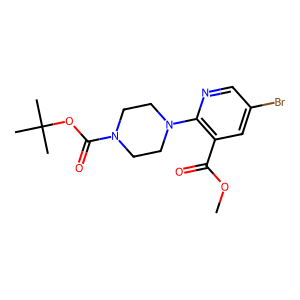
tert-Butyl 4-(5-bromo-3-(methoxycarbonyl)pyridin-2-yl)piperazine-1-carboxylate
CAS No.:
1000018-22-3
M. Wt:
400.26800
M. Fa:
C16H22BrN3O4
InChI Key:
YOCDALHJYLXODI-UHFFFAOYSA-N
Names and Identifiers of 1000018-22-3
CAS Number |
1000018-22-3 |
|---|---|
IUPAC Name |
tert-butyl 4-(5-bromo-3-methoxycarbonylpyridin-2-yl)piperazine-1-carboxylate |
InChI |
InChI=1S/C16H22BrN3O4/c1-16(2,3)24-15(22)20-7-5-19(6-8-20)13-12(14(21)23-4)9-11(17)10-18-13/h9-10H,5-8H2,1-4H3 |
InChIKey |
YOCDALHJYLXODI-UHFFFAOYSA-N |
Canonical SMILES |
CC(C)(C)OC(=O)N1CCN(CC1)C2=C(C=C(C=N2)Br)C(=O)OC |
Physical and chemical properties of 1000018-22-3
Acidity coefficient |
4.02±0.39(Predicted) |
|---|---|
Boiling Point |
484.9±45.0 °C(Predicted) |
Density |
1.393±0.06 g/cm3(Predicted) |
Exact Mass |
399.07900 |
LogP |
2.69070 |
Melting Point |
122-124°C |
Molecular Formula |
C16H22BrN3O4 |
Molecular Weight |
400.26800 |
PSA |
71.97000 |
Storage condition |
2-8°C |
Applications of 1000018-22-3
tert-Butyl 4-(5-bromo-3-(methoxycarbonyl)pyridin-2-yl)piperazine-1-carboxylate has potential applications in:
- Pharmaceutical Development: As an intermediate in the synthesis of bioactive compounds.
- Chemical Research: Useful in exploring structure-activity relationships due to its unique functional groups.
- Material Science: Potential use in developing new materials with specific properties due to its chemical structure.
Interaction Studies of 1000018-22-3
Interaction studies involving tert-butyl 4-(5-bromo-3-(methoxycarbonyl)pyridin-2-yl)piperazine-1-carboxylate could focus on:
- Protein Binding Studies: Understanding how this compound interacts with various proteins can provide insights into its pharmacokinetics.
- Receptor Binding Affinity: Investigating its affinity for neurotransmitter receptors could reveal its potential therapeutic applications.
- Metabolic Pathway Analysis: Studying how this compound is metabolized in biological systems can help predict its efficacy and safety profile.
Biological Activity of 1000018-22-3
While specific biological activity data for tert-butyl 4-(5-bromo-3-(methoxycarbonyl)pyridin-2-yl)piperazine-1-carboxylate is limited, compounds with similar structures often exhibit significant pharmacological properties. The presence of the piperazine moiety is associated with various biological activities, including:
- Antidepressant Effects: Piperazine derivatives are known to affect serotonin receptors.
- Antimicrobial Activity: Many brominated compounds display antimicrobial properties.
- CNS Activity: The pyridine ring contributes to potential central nervous system effects.
Further studies are needed to elucidate the specific biological effects of this compound.