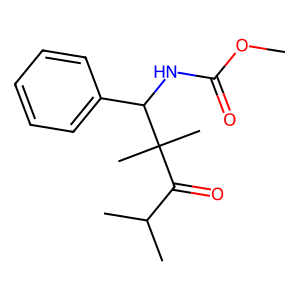
Methyl (2,2,4-triMethyl-3-oxo-1-phenylpentyl)carbaMate
CAS No.:
1000018-26-7
M. Wt:
277.35900
M. Fa:
C16H23NO3
InChI Key:
-
Names and Identifiers of 1000018-26-7
CAS Number |
1000018-26-7 |
|---|---|
IUPAC Name |
methyl N-(2,2,4-trimethyl-3-oxidanylidene-1-phenyl-pentyl)carbamate |
Canonical SMILES |
CC(C)C(=O)C(C)(C)C(C1=CC=CC=C1)NC(=O)OC |
Physical and chemical properties of 1000018-26-7
Acidity coefficient |
11.06±0.46(Predicted) |
|---|---|
Boiling Point |
402.9±38.0 °C(Predicted) |
Density |
1.047±0.06 g/cm3(Predicted) |
Exact Mass |
277.16800 |
LogP |
3.72590 |
Molecular Formula |
C16H23NO3 |
Molecular Weight |
277.35900 |
PSA |
55.40000 |
Storage condition |
2-8°C |
Applications of 1000018-26-7
Methyl (2,2,4-trimethyl-3-oxo-1-phenylpentyl)carbamate has potential applications in various fields:
- Pharmaceutical Research: Its unique structure makes it a candidate for drug development, particularly in targeting specific enzymes or receptors.
- Biochemical Studies: It can be utilized as a reagent in proteomics and other biochemical assays to study protein functions.
- Agricultural Chemistry: Due to its biological activity, it may find applications in agrochemicals as a pesticide or herbicide component.
These applications underscore the compound's versatility and importance in scientific research.
Biological Activity of 1000018-26-7
Research indicates that methyl (2,2,4-trimethyl-3-oxo-1-phenylpentyl)carbamate exhibits biological activity that may be relevant in pharmacological contexts. Preliminary studies suggest that this compound could interact with specific biological targets, although detailed mechanisms of action remain to be fully elucidated. It has been noted for its potential role in proteomics research, where it may serve as a biochemical tool for studying protein interactions and functions.