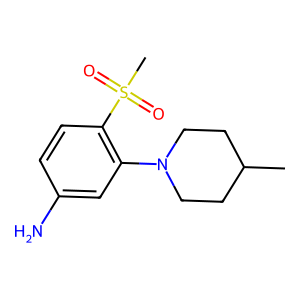
3-(4-Methylpiperidin-1-yl)-4-methylsulfonylaniline
Names and Identifiers of 1000018-37-0
CAS Number |
1000018-37-0 |
|---|---|
MDL Number |
MFCD09743719 |
IUPAC Name |
3-(4-methylpiperidin-1-yl)-4-methylsulfonylaniline |
InChI |
InChI=1S/C13H20N2O2S/c1-10-5-7-15(8-6-10)12-9-11(14)3-4-13(12)18(2,16)17/h3-4,9-10H,5-8,14H2,1-2H3 |
InChIKey |
GGGFTBUMXAXVCG-UHFFFAOYSA-N |
Canonical SMILES |
CC1CCN(CC1)C2=C(C=CC(=C2)N)S(=O)(=O)C |
UNSPSC Code |
12352100 |
Physical and chemical properties of 1000018-37-0
Molecular Formula |
C13H20N2O2S |
|---|---|
Molecular Weight |
268.38 |
Safety Information of 1000018-37-0

Applications of 1000018-37-0
3-(4-Methylpiperidin-1-yl)-4-methylsulfonylaniline finds applications in various fields:
- Medicinal Chemistry: It is investigated for its potential as a pharmaceutical agent, particularly in antiviral therapies.
- Material Science: The compound serves as an intermediate in the synthesis of more complex molecules used in developing materials with specific properties.
Interaction Studies of 1000018-37-0
Studies on the interactions of 3-(4-Methylpiperidin-1-yl)-4-methylsulfonylaniline with biological targets have shown promise in understanding its mechanism of action. The compound's ability to interact with enzymes and receptors suggests potential therapeutic applications, particularly in treating viral infections.
Biological Activity of 1000018-37-0
The biological activity of 3-(4-Methylpiperidin-1-yl)-4-methylsulfonylaniline is attributed to its interaction with various molecular targets, including enzymes and receptors. The piperidine moiety can facilitate binding to active sites, while the sulfonyl group may form hydrogen bonds, enhancing the compound's pharmacological properties. Research indicates that compounds of this class may exhibit anti-viral activities, particularly against viruses such as Hepatitis C.