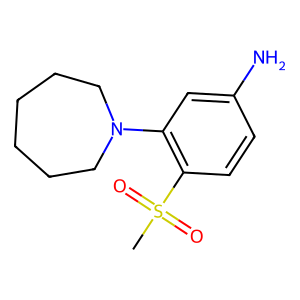
3-Azepan-1-yl-4-(methylsulphonyl)aniline
Names and Identifiers of 1000018-38-1
CAS Number |
1000018-38-1 |
|---|---|
MDL Number |
MFCD09750907 |
IUPAC Name |
3-(azepan-1-yl)-4-methylsulfonylaniline |
InChI |
InChI=1S/C13H20N2O2S/c1-18(16,17)13-7-6-11(14)10-12(13)15-8-4-2-3-5-9-15/h6-7,10H,2-5,8-9,14H2,1H3 |
InChIKey |
ABWKOIXHQDAFHG-UHFFFAOYSA-N |
Canonical SMILES |
CS(=O)(=O)C1=C(C=C(C=C1)N)N2CCCCCC2 |
UNSPSC Code |
12352100 |
Physical and chemical properties of 1000018-38-1
Boiling Point |
507.3±50.0 °C at 760 mmHg |
|---|---|
Density |
1.2±0.1 g/cm3 |
Exact Mass |
268.124542 |
Flash Point |
260.6±30.1 °C |
Index of Refraction |
1.571 |
LogP |
1.21 |
Molecular Formula |
C13H20N2O2S |
Molecular Weight |
268.375 |
Vapour Pressure |
0.0±1.3 mmHg at 25°C |
Safety Information of 1000018-38-1

Applications of 1000018-38-1
3-Azepan-1-yl-4-(methylsulphonyl)aniline has potential applications in various fields:
- Pharmaceutical Development: Due to its biological activity, it may serve as a lead compound for developing new drugs targeting infections or inflammation.
- Chemical Research: The compound's unique structure makes it a valuable subject for studies in organic chemistry and materials science.
- Agricultural Chemistry: Its potential antimicrobial properties could be explored for use in agricultural applications to protect crops from pathogens.
Interaction Studies of 1000018-38-1
Interaction studies involving 3-Azepan-1-yl-4-(methylsulphonyl)aniline focus on its binding affinity with biological targets such as enzymes or receptors. These studies are crucial for understanding its pharmacodynamics and potential therapeutic uses. Techniques such as molecular docking simulations and binding assays are often employed to evaluate these interactions.
Preliminary data suggest that the compound may interact with specific enzymes involved in metabolic pathways, which could influence its efficacy as a therapeutic agent.
Biological Activity of 1000018-38-1
Research indicates that compounds similar to 3-Azepan-1-yl-4-(methylsulphonyl)aniline exhibit various biological activities, including:
- Antimicrobial Properties: Some studies suggest that derivatives of this compound may possess antimicrobial activity against certain pathogens.
- Anti-inflammatory Effects: Compounds with similar structures are often investigated for their potential anti-inflammatory effects, making them candidates for therapeutic applications in inflammatory diseases.
- Cytotoxicity: Preliminary studies have indicated that certain analogs may exhibit cytotoxic effects against cancer cell lines, warranting further investigation into their mechanisms of action.