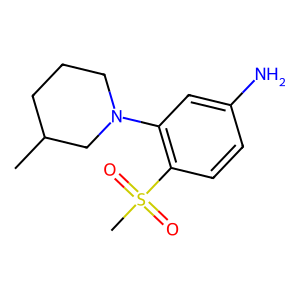
3-(3-Methylpiperidin-1-yl)-4-methylsulfonylaniline
Names and Identifiers of 1000018-39-2
CAS Number |
1000018-39-2 |
|---|---|
MDL Number |
MFCD09743723 |
IUPAC Name |
3-(3-methylpiperidin-1-yl)-4-methylsulfonylaniline |
InChI |
InChI=1S/C13H20N2O2S/c1-10-4-3-7-15(9-10)12-8-11(14)5-6-13(12)18(2,16)17/h5-6,8,10H,3-4,7,9,14H2,1-2H3 |
InChIKey |
CFXUFCWEYPFZRN-UHFFFAOYSA-N |
Canonical SMILES |
CC1CCCN(C1)C2=C(C=CC(=C2)N)S(=O)(=O)C |
UNSPSC Code |
12352100 |
Physical and chemical properties of 1000018-39-2
Exact Mass |
268.12500 |
|---|---|
LogP |
3.63560 |
Molecular Formula |
C13H20N2O2S |
Molecular Weight |
268.37500 |
PSA |
71.78000 |
Safety Information of 1000018-39-2

Applications of 1000018-39-2
The applications of 3-(3-Methylpiperidin-1-yl)-4-methylsulfonylaniline span various fields:
- Pharmaceutical Development: As a potential lead compound for drug development targeting neurological disorders.
- Chemical Research: Utilized in synthetic chemistry for developing more complex molecules.
- Biochemical Studies: Employed in proteomics research to understand protein interactions and functions.
Interaction Studies of 1000018-39-2
Interaction studies involving this compound focus on its binding affinity to specific receptors or enzymes. Preliminary data suggest that it may interact with neurotransmitter systems, although detailed mechanisms remain to be elucidated. Such studies are crucial for determining its pharmacological profile and therapeutic potential.
Biological Activity of 1000018-39-2
This compound has shown potential biological activity, particularly in pharmacological contexts. Its structure suggests that it may interact with various biological targets, including receptors and enzymes involved in neurotransmission and other physiological processes. Specific studies have indicated that compounds with similar structures may exhibit anti-inflammatory and analgesic properties.