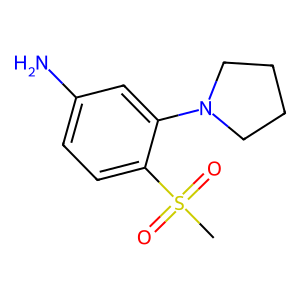
4-Methylsulfonyl-3-(pyrrolidin-1-yl)aniline
Names and Identifiers of 1000018-40-5
CAS Number |
1000018-40-5 |
|---|---|
MDL Number |
MFCD09743724 |
IUPAC Name |
4-methylsulfonyl-3-pyrrolidin-1-ylaniline |
InChI |
InChI=1S/C11H16N2O2S/c1-16(14,15)11-5-4-9(12)8-10(11)13-6-2-3-7-13/h4-5,8H,2-3,6-7,12H2,1H3 |
InChIKey |
AMMYEUZBQIIWPL-UHFFFAOYSA-N |
Canonical SMILES |
CS(=O)(=O)C1=CC=C(N)C=C1N1CCCC1 |
UNSPSC Code |
12352100 |
Physical and chemical properties of 1000018-40-5
Exact Mass |
240.09300 |
|---|---|
LogP |
2.99950 |
Molecular Formula |
C11H16N2O2S |
Molecular Weight |
240.32200 |
PSA |
71.78000 |
Safety Information of 1000018-40-5

Applications of 1000018-40-5
4-Methylsulfonyl-3-(pyrrolidin-1-yl)aniline has diverse applications:
- Chemistry: It serves as a building block for synthesizing more complex organic molecules.
- Biology: Utilized in enzyme interaction studies and biochemical assays.
- Industry: Functions as an intermediate in pharmaceutical synthesis and the production of specialty chemicals.
Interaction Studies of 1000018-40-5
Interaction studies focus on how 4-Methylsulfonyl-3-(pyrrolidin-1-yl)aniline interacts with various biological targets. These studies are crucial for understanding its potential therapeutic effects and mechanisms of action. Research indicates that this compound can influence enzyme activity and receptor binding, which may lead to implications in drug development.
Biological Activity of 1000018-40-5
The biological activity of 4-Methylsulfonyl-3-(pyrrolidin-1-yl)aniline is linked to its interaction with specific enzymes or receptors. The methylsulfonyl group can form hydrogen bonds with active site residues, while the pyrrolidinyl group enhances binding affinity through hydrophobic interactions. These interactions can modulate the activity of target proteins, leading to various biological effects that are currently being explored in pharmacological studies.