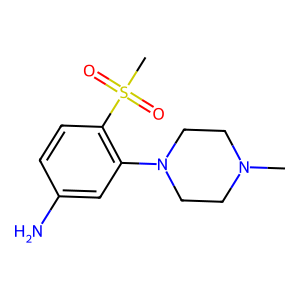
3-(1-Methylpiperazin-4-yl)-4-methylsulfonylaniline
CAS No.:
1000018-41-6
M. Wt:
269.363
M. Fa:
C12H19N3O2S
InChI Key:
DOUDCOIBGXDQBS-UHFFFAOYSA-N
Names and Identifiers of 1000018-41-6
CAS Number |
1000018-41-6 |
|---|---|
IUPAC Name |
3-(4-methylpiperazin-1-yl)-4-methylsulfonylaniline |
InChI |
InChI=1S/C12H19N3O2S/c1-14-5-7-15(8-6-14)11-9-10(13)3-4-12(11)18(2,16)17/h3-4,9H,5-8,13H2,1-2H3 |
InChIKey |
DOUDCOIBGXDQBS-UHFFFAOYSA-N |
Canonical SMILES |
CN1CCN(CC1)C2=C(C=CC(=C2)N)S(=O)(=O)C |
Physical and chemical properties of 1000018-41-6
Acidity coefficient |
7.63±0.42(Predicted) |
|---|---|
Boiling Point |
500.9±50.0 °C at 760 mmHg |
Density |
1.2±0.1 g/cm3 |
Exact Mass |
269.119812 |
Flash Point |
256.7±30.1 °C |
Index of Refraction |
1.585 |
LogP |
-0.54 |
Molecular Formula |
C12H19N3O2S |
Molecular Weight |
269.363 |
Vapour Pressure |
0.0±1.3 mmHg at 25°C |
Applications of 1000018-41-6
This compound finds applications primarily in:
- Pharmaceutical Development: It serves as a lead compound in drug discovery, particularly for central nervous system disorders.
- Biochemical Research: Utilized in proteomics research to study protein interactions and modifications.
- Material Science: Potential use in developing novel materials due to its unique chemical properties.
Interaction Studies of 1000018-41-6
Interaction studies of 3-(1-Methylpiperazin-4-yl)-4-methylsulfonylaniline focus on its binding affinities with various biological targets. These studies often employ techniques such as:
- Molecular Docking: To predict how the compound interacts with specific receptors or enzymes.
- In Vitro Assays: To evaluate its efficacy and potency against biological targets related to neurotransmission and other physiological processes.
Biological Activity of 1000018-41-6
3-(1-Methylpiperazin-4-yl)-4-methylsulfonylaniline exhibits significant biological activity, particularly as a pharmacological agent. It has been studied for its potential effects on neurotransmitter systems and may have applications in treating psychiatric disorders. The presence of the piperazine moiety often correlates with enhanced binding affinity to various receptors, making it a candidate for drug development.