
5-(2,6-Dimethylmorpholin-4-yl)-2-nitrobenzoic acid
Names and Identifiers of 1000018-44-9
CAS Number |
1000018-44-9 |
|---|---|
MDL Number |
MFCD09743728 |
IUPAC Name |
5-(2,6-dimethylmorpholin-4-yl)-2-nitrobenzoic acid |
InChI |
InChI=1S/C13H16N2O5/c1-8-6-14(7-9(2)20-8)10-3-4-12(15(18)19)11(5-10)13(16)17/h3-5,8-9H,6-7H2,1-2H3,(H,16,17) |
InChIKey |
VWTUGTCIUKZKLA-UHFFFAOYSA-N |
Canonical SMILES |
CC1CN(C2=CC=C([N+](=O)[O-])C(C(=O)O)=C2)CC(C)O1 |
UNSPSC Code |
12352100 |
Physical and chemical properties of 1000018-44-9
Exact Mass |
280.10600 |
|---|---|
LogP |
2.49480 |
Melting Point |
201 to 203°C |
Molecular Formula |
C13H16N2O5 |
Molecular Weight |
280.27700 |
PSA |
95.59000 |
Safety Information of 1000018-44-9

Applications of 1000018-44-9
5-(2,6-Dimethylmorpholin-4-yl)-2-nitrobenzoic acid has diverse applications in various fields:
- Chemistry: Serves as a building block for synthesizing more complex molecules.
- Biology: Investigated for its potential as a biochemical probe due to its unique structural features.
- Medicine: Explored for therapeutic properties such as anti-inflammatory and antimicrobial effects.
- Industry: Utilized in developing new materials and as an intermediate in pharmaceutical synthesis.
Interaction Studies of 1000018-44-9
Studies on the interactions of 5-(2,6-Dimethylmorpholin-4-yl)-2-nitrobenzoic acid with biological targets have shown that it may affect various cellular pathways. The reduction of the nitro group can lead to different biological effects depending on the resulting intermediates formed during reactions. Research continues into how these interactions can be harnessed for therapeutic applications.
Similar Compounds: ComparisonSeveral compounds share structural similarities with 5-(2,6-Dimethylmorpholin-4-yl)-2-nitrobenzoic acid:
| Compound Name | Key Features |
|---|---|
| 2,6-Dimethylmorpholine | A simpler analog without the nitrobenzoic acid moiety. |
| 5-Nitrobenzoic Acid | Lacks the morpholine ring but retains the nitro group. |
| 2-(2,6-Dimethylmorpholino)-benzoic Acid | Similar structure but without the nitro group. |
Biological Activity of 1000018-44-9
Research indicates that 5-(2,6-Dimethylmorpholin-4-yl)-2-nitrobenzoic acid exhibits significant biological activity. Its mechanism of action may involve interaction with specific molecular targets, where the nitro group can be reduced to form reactive intermediates that affect cellular components. The morpholine ring is believed to enhance its ability to interact with biological membranes and proteins. Studies have explored its potential as a biochemical probe and its therapeutic properties, including anti-inflammatory and antimicrobial activities.
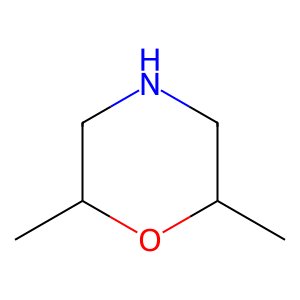 Cas:141-91-3

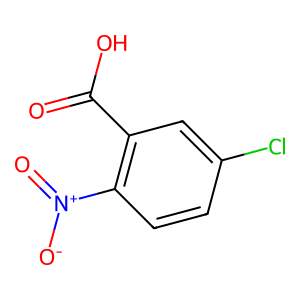 Cas:2516-95-2
