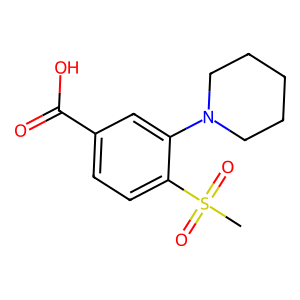
4-Methylsulfonyl-3-(piperidin-1-yl)benzoicacid
Names and Identifiers of 1000018-47-2
CAS Number |
1000018-47-2 |
|---|---|
MDL Number |
MFCD09743731 |
IUPAC Name |
4-methylsulfonyl-3-piperidin-1-ylbenzoic acid |
InChI |
InChI=1S/C13H17NO4S/c1-19(17,18)12-6-5-10(13(15)16)9-11(12)14-7-3-2-4-8-14/h5-6,9H,2-4,7-8H2,1H3,(H,15,16) |
InChIKey |
CBYNXNKBSCPATK-UHFFFAOYSA-N |
Canonical SMILES |
CS(=O)(=O)C1=CC=C(C(=O)O)C=C1N1CCCCC1 |
UNSPSC Code |
12352100 |
Physical and chemical properties of 1000018-47-2
Molecular Formula |
C13H17NO4S |
|---|---|
Molecular Weight |
283.34 |
Safety Information of 1000018-47-2

Applications of 1000018-47-2
4-Methylsulfonyl-3-(piperidin-1-yl)benzoic acid has several applications, including:
- Pharmaceutical Development: As a potential lead compound for new therapeutic agents targeting inflammation or pain.
- Research Reagent: Utilized in biochemical studies to explore cellular mechanisms and drug interactions.
- Chemical Intermediate: Serves as a precursor for synthesizing more complex pharmaceutical compounds.
Interaction Studies of 1000018-47-2
Studies on the interactions of 4-Methylsulfonyl-3-(piperidin-1-yl)benzoic acid with various receptors and enzymes are crucial for understanding its pharmacological profile. Preliminary research suggests that it may modulate specific signaling pathways, although further investigation is needed to elucidate its complete interaction landscape.
Biological Activity of 1000018-47-2
The biological activity of 4-Methylsulfonyl-3-(piperidin-1-yl)benzoic acid has been explored in several studies. It exhibits potential anti-inflammatory and analgesic properties, making it a candidate for therapeutic applications. The compound may also interact with various biological pathways, influencing cellular processes and signaling mechanisms.