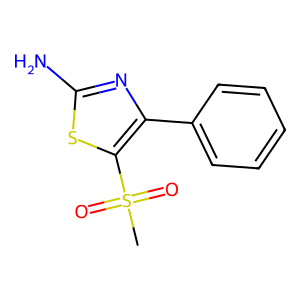
2-Amino-5-methylsulfonyl-4-phenyl-1,3-thiazole
CAS No.:
1000018-51-8
M. Wt:
254.32900
M. Fa:
C10H10N2O2S2
InChI Key:
MENYNNGOWMJUEG-UHFFFAOYSA-N
Appearance:
Solid
Names and Identifiers of 1000018-51-8
CAS Number |
1000018-51-8 |
|---|---|
MDL Number |
MFCD09743736 |
IUPAC Name |
5-methylsulfonyl-4-phenyl-1,3-thiazol-2-amine |
InChI |
InChI=1S/C10H10N2O2S2/c1-16(13,14)9-8(12-10(11)15-9)7-5-3-2-4-6-7/h2-6H,1H3,(H2,11,12) |
InChIKey |
MENYNNGOWMJUEG-UHFFFAOYSA-N |
Canonical SMILES |
CS(=O)(=O)C1=C(N=C(S1)N)C2=CC=CC=C2 |
UNSPSC Code |
12352100 |
Physical and chemical properties of 1000018-51-8
Acidity coefficient |
1.03±0.10(Predicted) |
|---|---|
Boiling Point |
541.1±42.0 °C(Predicted) |
Density |
1.401±0.06 g/cm3(Predicted) |
Exact Mass |
254.01800 |
LogP |
3.45780 |
Molecular Formula |
C10H10N2O2S2 |
Molecular Weight |
254.32900 |
PSA |
109.67000 |
Safety Information of 1000018-51-8

Applications of 1000018-51-8
The compound's unique structure and biological activity make it suitable for various applications:
- Pharmaceutical Intermediates: It serves as an intermediate in the synthesis of pharmaceuticals, particularly those targeting infectious diseases.
- Research Tools: Its properties make it valuable in biochemical research for studying enzyme interactions and metabolic pathways.
Interaction Studies of 1000018-51-8
Interaction studies involving 2-amino-5-methylsulfonyl-4-phenyl-1,3-thiazole focus on its reactivity with other biological molecules. These studies often assess:
- Binding Affinity: How well the compound interacts with specific enzymes or receptors.
- Mechanism of Action: Understanding how it exerts its biological effects at the molecular level.
Such studies are crucial for developing new therapeutic agents based on this compound.
Biological Activity of 1000018-51-8
Research indicates that derivatives of 2-amino-5-methylsulfonyl-4-phenyl-1,3-thiazole exhibit various biological activities. These include:
- Antimicrobial Activity: Studies have shown that thiazole derivatives possess significant antibacterial properties against a range of pathogens.
- Antileishmanial Activity: Some derivatives have been explored for their potential in treating leishmaniasis, showing promising results against trypanosomatids.
- Antioxidant Properties: The compound has also been investigated for its antioxidant capabilities, which could have implications in preventing oxidative stress-related diseases.