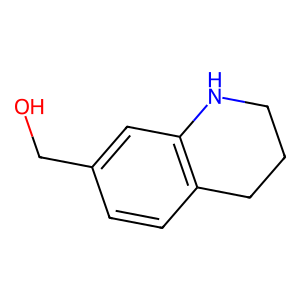
(1,2,3,4-Tetrahydroquinolin-7-yl)methanol
CAS No.:
1000045-81-7
M. Wt:
163.22
M. Fa:
C10H13NO
InChI Key:
CTRBFJUGIGJMCH-UHFFFAOYSA-N
Names and Identifiers of 1000045-81-7
CAS Number |
1000045-81-7 |
|---|---|
EC Number |
868-089-6 |
IUPAC Name |
1,2,3,4-tetrahydroquinolin-7-ylmethanol |
InChI |
InChI=1S/C10H13NO/c12-7-8-3-4-9-2-1-5-11-10(9)6-8/h3-4,6,11-12H,1-2,5,7H2 |
InChIKey |
CTRBFJUGIGJMCH-UHFFFAOYSA-N |
Canonical SMILES |
C1CC2=C(C=C(C=C2)CO)NC1 |
Physical and chemical properties of 1000045-81-7
Boiling Point |
339.5±21.0 °C(Predicted) |
|---|---|
Density |
1.117±0.06 g/cm3(Predicted) |
Molecular Formula |
C10H13NO |
Molecular Weight |
163.22 |
Safety Information of 1000045-81-7

Applications of 1000045-81-7
(1,2,3,4-Tetrahydroquinolin-7-yl)methanol has several potential applications:
- Pharmaceuticals: Its derivatives are being explored for their roles in treating neurodegenerative diseases and cancers.
- Biochemical Research: As a model compound, it aids in studying enzyme interactions and metabolic pathways.
- Material Science: Its unique structure may find applications in developing novel materials with specific properties.
Interaction Studies of 1000045-81-7
Studies on (1,2,3,4-Tetrahydroquinolin-7-yl)methanol have focused on its interactions with various biological targets:
- Enzyme Inhibition Studies: Compounds based on this structure have been evaluated for their inhibitory effects on acetylcholinesterase and other enzymes involved in neurotransmission and metabolism.
- Binding Affinity Assessments: Research has assessed how these compounds bind to specific receptors or enzymes, providing insights into their pharmacological potential.
Biological Activity of 1000045-81-7
Research indicates that (1,2,3,4-Tetrahydroquinolin-7-yl)methanol exhibits various biological activities. Notably:
- Acetylcholinesterase Inhibition: Compounds derived from tetrahydroquinoline structures have been studied for their potential in treating Alzheimer's disease due to their ability to inhibit acetylcholinesterase.
- Antitumor Activity: Some derivatives have shown promising results in antitumor assays, indicating potential applications in cancer therapy.
- CYP Enzyme Interaction: This compound interacts with cytochrome P450 enzymes, particularly CYP1A2, suggesting implications for drug metabolism and pharmacokinetics.