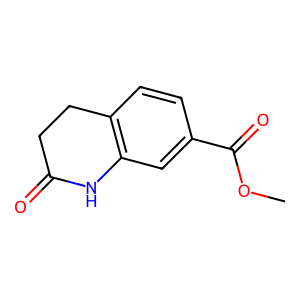
Methyl 2-oxo-1,2,3,4-tetrahydroquinoline-7-carboxylate
CAS No.:
1000045-93-1
M. Wt:
205.210
M. Fa:
C11H11NO3
InChI Key:
BUGJUSPLIAWGKT-UHFFFAOYSA-N
Appearance:
Pale-yellow Solid
Names and Identifiers of 1000045-93-1
CAS Number |
1000045-93-1 |
|---|---|
MDL Number |
MFCD24387120 |
IUPAC Name |
methyl 2-oxo-3,4-dihydro-1H-quinoline-7-carboxylate |
InChI |
InChI=1S/C11H11NO3/c1-15-11(14)8-3-2-7-4-5-10(13)12-9(7)6-8/h2-3,6H,4-5H2,1H3,(H,12,13) |
InChIKey |
BUGJUSPLIAWGKT-UHFFFAOYSA-N |
Canonical SMILES |
COC(=O)C1=CC2=C(CCC(=O)N2)C=C1 |
UNSPSC Code |
12352100 |
Physical and chemical properties of 1000045-93-1
Boiling Point |
402.4±45.0 °C at 760 mmHg |
|---|---|
Density |
1.2±0.1 g/cm3 |
Exact Mass |
205.073898 |
Flash Point |
197.2±28.7 °C |
Index of Refraction |
1.557 |
LogP |
1.72 |
Molecular Formula |
C11H11NO3 |
Molecular Weight |
205.210 |
Storage condition |
Sealed in dry,Room Temperature |
Vapour Pressure |
0.0±0.9 mmHg at 25°C |
Safety Information of 1000045-93-1

Applications of 1000045-93-1
Methyl 2-oxo-1,2,3,4-tetrahydroquinoline-7-carboxylate finds applications in various fields:
- Pharmaceuticals: Due to its biological activities, it is being explored as a lead compound for developing new antimicrobial and anticancer drugs.
- Chemical Research: It serves as an intermediate in organic synthesis for creating more complex heterocyclic compounds.
Interaction Studies of 1000045-93-1
Interaction studies have revealed that methyl 2-oxo-1,2,3,4-tetrahydroquinoline-7-carboxylate interacts with several biological targets:
- Enzyme Interactions: It has been shown to inhibit specific enzymes involved in drug metabolism, which could impact pharmacokinetics and drug-drug interactions.
- Binding Affinity Studies: Molecular docking studies suggest favorable binding interactions with proteins relevant to cancer treatment pathways.
Biological Activity of 1000045-93-1
Methyl 2-oxo-1,2,3,4-tetrahydroquinoline-7-carboxylate exhibits significant biological activities:
- Antimicrobial Properties: Studies have indicated that this compound may possess antimicrobial effects against various pathogens.
- Anticancer Activity: Preliminary research suggests potential anticancer properties, making it a candidate for further pharmacological studies.
- Enzyme Inhibition: The compound has been identified as an inhibitor of certain cytochrome P450 enzymes, which are crucial in drug metabolism.