
(1-(tert-Butoxycarbonyl)-4-fluoro-1H-indol-2-yl)boronic acid
CAS No.:
1000068-25-6
M. Wt:
279.07200
M. Fa:
C13H15BFNO4
InChI Key:
GIHZCAVQMVZATP-UHFFFAOYSA-N
Appearance:
White To Off-White Solid
Names and Identifiers of 1000068-25-6
CAS Number |
1000068-25-6 |
|---|---|
MDL Number |
MFCD11109421 |
IUPAC Name |
[4-fluoro-1-[(2-methylpropan-2-yl)oxycarbonyl]indol-2-yl]boronic acid |
InChI |
InChI=1S/C13H15BFNO4/c1-13(2,3)20-12(17)16-10-6-4-5-9(15)8(10)7-11(16)14(18)19/h4-7,18-19H,1-3H3 |
InChIKey |
GIHZCAVQMVZATP-UHFFFAOYSA-N |
Canonical SMILES |
B(C1=CC2=C(N1C(=O)OC(C)(C)C)C=CC=C2F)(O)O |
UNSPSC Code |
12352100 |
Physical and chemical properties of 1000068-25-6
Exact Mass |
279.10800 |
|---|---|
LogP |
1.24340 |
Molecular Formula |
C13H15BFNO4 |
Molecular Weight |
279.07200 |
PSA |
71.69000 |
Storage condition |
2-8°C |
Safety Information of 1000068-25-6

Applications of 1000068-25-6
The applications of (1-(tert-Butoxycarbonyl)-4-fluoro-1H-indol-2-yl)boronic acid span various fields:
- Pharmaceutical Development: Its role as a building block in drug synthesis makes it valuable in the pharmaceutical industry for developing new therapeutic agents.
- Material Science: It can be used in synthesizing functional materials that require specific interactions with biological molecules or sensors.
- Chemical Probes: Due to its ability to bind selectively to diols, it serves as a chemical probe in biochemical assays.
Interaction Studies of 1000068-25-6
Interaction studies involving (1-(tert-Butoxycarbonyl)-4-fluoro-1H-indol-2-yl)boronic acid focus on its binding affinity and selectivity towards biological targets. These studies often utilize:
- Surface Plasmon Resonance (SPR): To measure real-time binding interactions with target proteins.
- NMR Spectroscopy: To elucidate binding modes and affinities in complex mixtures.
These techniques help in understanding how modifications to the compound affect its biological activity and selectivity.
Biological Activity of 1000068-25-6
Boronic acids, including (1-(tert-Butoxycarbonyl)-4-fluoro-1H-indol-2-yl)boronic acid, exhibit various biological activities:
- Enzyme Inhibition: This compound has potential as an enzyme inhibitor, particularly against serine proteases and other enzymes that utilize diols in their active sites.
- Anticancer Properties: Some studies suggest that indole derivatives possess anticancer activity, potentially through mechanisms involving apoptosis induction or cell cycle arrest.
- Antimicrobial Activity: Compounds with indole structures have been reported to exhibit antimicrobial properties, making this derivative a candidate for further investigation in this area.
Physical sample testing spectrum (NMR) of 1000068-25-6

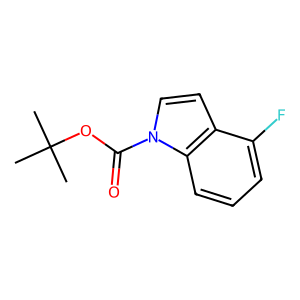 Cas:129822-45-3

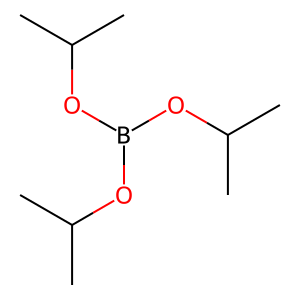 Cas:5419-55-6

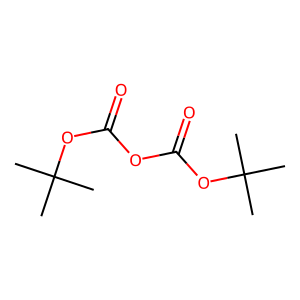 Cas:24424-99-5