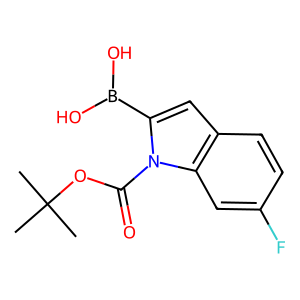
(1-(tert-Butoxycarbonyl)-6-fluoro-1H-indol-2-yl)boronic acid
CAS No.:
1000068-26-7
M. Wt:
279.07200
M. Fa:
C13H15BFNO4
InChI Key:
GARRUKBUEWVRCV-UHFFFAOYSA-N
Appearance:
White Solid
Names and Identifiers of 1000068-26-7
CAS Number |
1000068-26-7 |
|---|---|
MDL Number |
MFCD09953519 |
IUPAC Name |
[6-fluoro-1-[(2-methylpropan-2-yl)oxycarbonyl]indol-2-yl]boronic acid |
InChI |
InChI=1S/C13H15BFNO4/c1-13(2,3)20-12(17)16-10-7-9(15)5-4-8(10)6-11(16)14(18)19/h4-7,18-19H,1-3H3 |
InChIKey |
GARRUKBUEWVRCV-UHFFFAOYSA-N |
Canonical SMILES |
B(C1=CC2=C(N1C(=O)OC(C)(C)C)C=C(C=C2)F)(O)O |
UNSPSC Code |
12352100 |
Physical and chemical properties of 1000068-26-7
Exact Mass |
279.10800 |
|---|---|
LogP |
1.24340 |
Molecular Formula |
C13H15BFNO4 |
Molecular Weight |
279.07200 |
PSA |
71.69000 |
Storage condition |
Sealed in dry,Store in freezer, under -20°C |
Safety Information of 1000068-26-7

Applications of 1000068-26-7
(1-(tert-Butoxycarbonyl)-6-fluoro-1H-indol-2-yl)boronic acid has potential applications in various fields:
- Pharmaceutical Development: Due to its biological activity, it may serve as a lead compound in drug discovery efforts targeting cancer or metabolic diseases.
- Chemical Research: Its unique structure makes it a valuable reagent in synthetic organic chemistry for developing new materials or compounds.
Interaction Studies of 1000068-26-7
Interaction studies involving (1-(tert-Butoxycarbonyl)-6-fluoro-1H-indol-2-yl)boronic acid focus on its binding affinity and interactions with biological targets. Techniques such as surface plasmon resonance and fluorescence spectroscopy can be employed to assess these interactions, providing insights into its mechanism of action and potential therapeutic effects.
Biological Activity of 1000068-26-7
The biological activity of (1-(tert-Butoxycarbonyl)-6-fluoro-1H-indol-2-yl)boronic acid is an area of ongoing research. Compounds containing boronic acids have been noted for their potential therapeutic applications, including:
- Anticancer Activity: Boronic acids can inhibit proteasome activity, leading to apoptosis in cancer cells. Their ability to modulate cellular pathways makes them candidates for anticancer drug development.
- Antidiabetic Properties: Some studies suggest that boronic acids may enhance insulin signaling or modulate glucose metabolism, indicating potential use in diabetes management.
Physical sample testing spectrum (NMR) of 1000068-26-7
