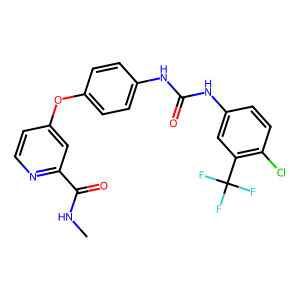
Sorafenib
CAS No.:
100012-18-8
M. Wt:
909
M. Fa:
C44H36MnN8Cl5
InChI Key:
MLDQJTXFUGDVEO-UHFFFAOYSA-N
Names and Identifiers of 100012-18-8
CAS Number |
100012-18-8 |
|---|---|
EC Number |
608-209-4 |
IUPAC Name |
4-[4-[[4-chloro-3-(trifluoromethyl)phenyl]carbamoylamino]phenoxy]-N-methylpyridine-2-carboxamide |
InChI |
InChI=1S/C21H16ClF3N4O3/c1-26-19(30)18-11-15(8-9-27-18)32-14-5-2-12(3-6-14)28-20(31)29-13-4-7-17(22)16(10-13)21(23,24)25/h2-11H,1H3,(H,26,30)(H2,28,29,31) |
InChIKey |
MLDQJTXFUGDVEO-UHFFFAOYSA-N |
Canonical SMILES |
CNC(=O)C1=NC=CC(=C1)OC2=CC=C(C=C2)NC(=O)NC3=CC(=C(C=C3)Cl)C(F)(F)F |
UNII |
9ZOQ3TZI87 |
Physical and chemical properties of 100012-18-8
Boiling Point |
523.3±50.0 °C at 760 mmHg |
|---|---|
Decomposition |
Dangerous products of decomposition: thermal ecomposition may produce toxic gases such as carbon monoxide, carbon dioxide, and nitrogen oxides. /Sorafenib tosylate/ |
Density |
1.5±0.1 g/cm3 |
Exact Mass |
464.086304 |
Flash Point |
270.3±30.1 °C |
Index of Refraction |
1.626 |
LogP |
3.8 |
Melting Point |
205.6 °C |
Molecular Formula |
C44H36MnN8Cl5 |
Molecular Weight |
909 |
Stability |
Stable if stored as directed; avoid strong oxidizing agents. /Sorafenib tosylate/ |
Vapour density |
4.11X10⁻¹⁴ mm Hg at 25 °C (est) |
Vapour Pressure |
0.0±1.4 mmHg at 25°C |
Water Solubility |
Soluble in water, 0.1M TRIS-HCl, pH 9.0 containing 1mM EDTA (>50 mg/ml), and PBS, pH 7.2 (4 mg/ml). |
Safety Information of 100012-18-8


Interaction Studies of 100012-18-8
Studies have demonstrated that sorafenib interacts with various cellular pathways:
- Tyrosine Kinase Inhibition: Its primary mechanism involves inhibiting multiple receptor tyrosine kinases, which play crucial roles in cancer cell signaling and angiogenesis.
- Drug Resistance Mechanisms: Research has highlighted noncoding RNAs' roles in mediating resistance to sorafenib, indicating complex interactions at the molecular level that can affect treatment efficacy.
Biological Activity of 100012-18-8
Sorafenib exhibits potent anti-cancer activity through multiple mechanisms:
- Inhibition of Tumor Cell Proliferation: By blocking the Raf/MEK/ERK signaling pathway, sorafenib effectively inhibits cell proliferation and induces apoptosis in tumor cells.
- Angiogenesis Inhibition: Sorafenib disrupts angiogenesis by inhibiting the autophosphorylation of receptor tyrosine kinases involved in endothelial cell signaling, particularly VEGFRs and PDGFRs.
- Resistance Mechanisms: Despite its efficacy, resistance to sorafenib can develop through various mechanisms such as activation of alternative signaling pathways (e.g., PI3K/Akt) and upregulation of ATP-binding cassette transporters that expel the drug from cells.